
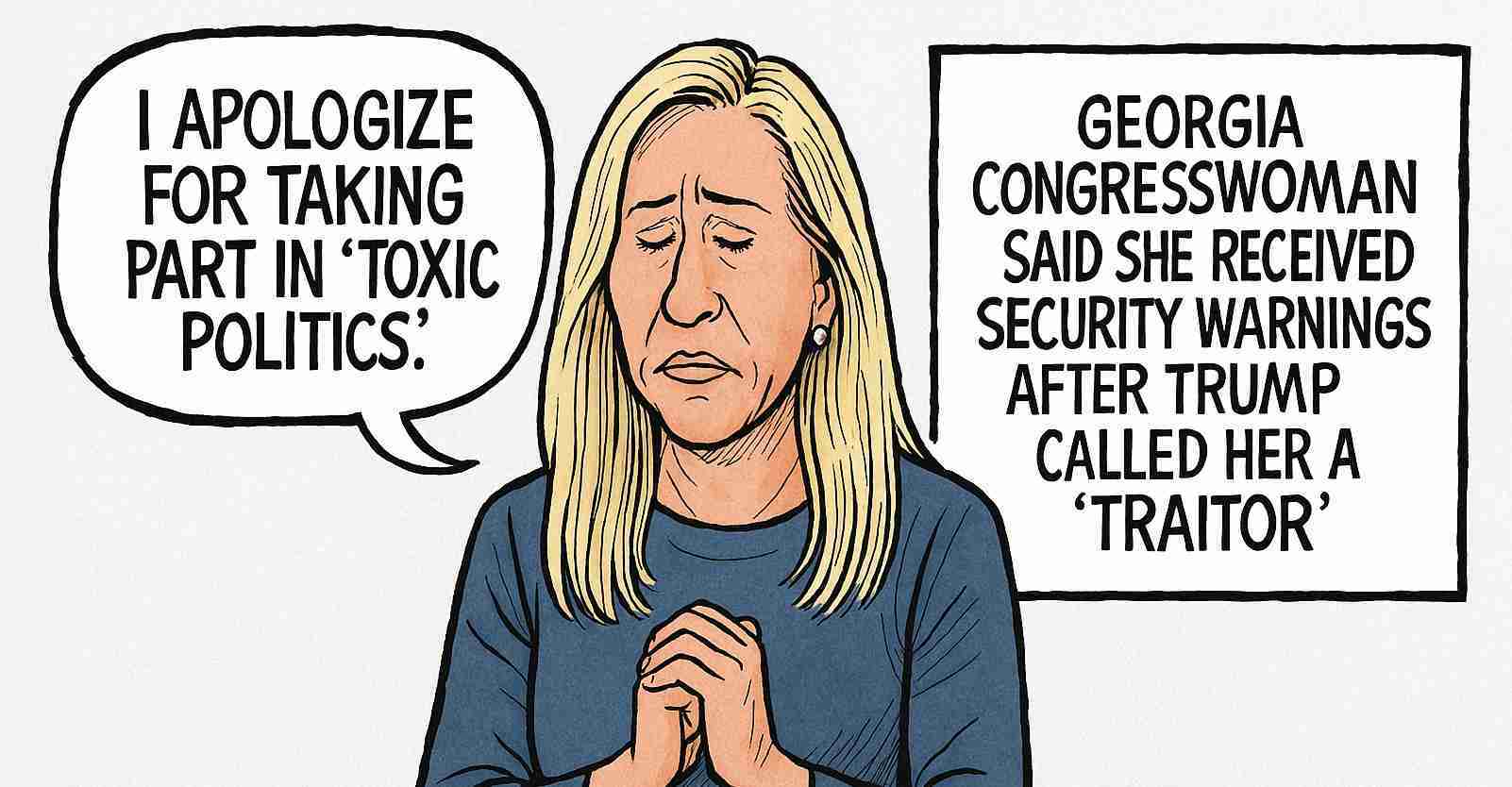
Marjorie Taylor Greene apologizes for taking part in “toxic politics” after Trump attacks; says she received security warnings
ROME, Georgia — On Nov. 16, 2025, Rep. Marjorie Taylor Greene apologized on CNN’s State of the Union for engaging in “toxic politics,” saying she wants to “put down the knives” amid heightened safety warnings after public attacks by former President Donald Trump.
- On-air apology: Greene told CNN she was “sorry for taking part in the toxic politics” and wants to see people treat one another with more kindness.
- Feud with Trump: The apology followed Trump’s Truth Social posts withdrawing his endorsement and calling Greene a “traitor” and “RINO,” which she says fueled threats.
- Security warnings: Greene said private security firms warned of increased threats and that her daughter asked the public to “pray for my mom’s safety.”
- Policy split: The rift centers partly on Greene’s push to release Department of Justice files related to Jeffrey Epstein and her media appearances, which Trump criticized.
On-air apology: “I’m sorry for taking part in the toxic politics”
On Nov. 16, 2025, appearing on CNN’s State of the Union, Greene offered a public mea culpa:
“I would like to say, humbly, I’m sorry for taking part in the toxic politics. It’s very bad for our country… I am committed to putting down the knives in politics. I really just want to see people be kind to one another.”
She told the program that recent acts of political violence and threats had prompted reflection and motivated a change in tone.
Trump’s attacks and the security warnings
The apology followed a public falling-out with former President Donald Trump, who withdrew his support for Greene’s re-election and posted harsh criticisms on Truth Social, labeling her a “traitor” and “RINO.” Greene said those posts helped fuel a spike in threatening messages and led private security firms to alert her to heightened risks.
Greene wrote on social media: “I am now being contacted by private security firms with warnings for my safety as a hotbed of threats against me are being fueled and egged on by the most powerful man in the world. The man I supported and helped get elected.” She also noted her daughter publicly asked supporters to “pray for my mom’s safety,” illustrating family concern over the escalation.
Feud over Epstein files, media appearances and party independence
The rift is partly rooted in policy disagreements and partly in style. One flashpoint was Greene’s push to release Department of Justice files related to Jeffrey Epstein; she framed that effort as supporting survivors and demanding transparency. Trump criticized her media appearances, including a recent slot on the daytime show The View, saying she had “gone far left.”
Greene’s willingness to break with party orthodoxy has made her a more independent GOP voice — and exposed her to political risk, including withdrawal of endorsements and intra-party attacks.
Security context and the broader climate of threats
Greene used the interview to link her personal experience to a national pattern: experts say incendiary public language, especially from high-profile figures, can increase both online and real-world risk. While Greene did not provide full specifics about the private advisories, she underscored how public attacks can generate private safety concerns.
Security researchers note that officials under intense scrutiny often receive private security assessments from firms that monitor hostile chatter and threats — a dynamic Greene highlighted in describing her warnings.
Political implications within the Republican Party
Greene’s apology draws attention to GOP internal dynamics: balancing loyalty to Trump with efforts to expand the party’s appeal. Analysts say an open break between a House member and a former president who retains strong influence can affect fundraising, endorsements and primary challenges.
Greene’s stated desire to “move past bitterness” could be interpreted as a campaign-stabilizing move or a genuine shift prompted by safety concerns — either way, it changes how she’ll be perceived by colleagues and voters.
Local angle: why this matters beyond Georgia
Although the dispute centers on a Georgia congresswoman and a former president, the fallout has national resonance, including in places like Las Vegas. High-profile feuds affect donor behavior, event planning and community safety conversations in battleground states.
Implications for Las Vegas, Nevada
- Economic impact: Donor flows could shift if national funders realign; Las Vegas campaigns and vendors might feel effects in advertising and consulting work.
- Tourism and events: High-profile tensions can raise security costs for venues hosting political events and fundraisers.
- Political consequences: Local Republicans may recalibrate messaging — moderates might emphasize civility while Trump-aligned factions test loyalty dynamics.
- Social effects: Community leaders may see increased pressure to address safety at public forums and curb neighborhood polarization.
Practical applications for residents
Community organizers, schools and civic groups in Las Vegas should review event security and prepare responses to online threats tied to national controversies. Campaigns may pivot to de-escalation messaging aimed at urban-moderate voters, while civic leaders can host dialogues and de-escalation workshops.
Sources and reporting notes
Reporting for this story included review of Greene’s public statements on CNN and social media, congressional records and commentary from public safety experts. Primary sources cited:
- CNN’s “State of the Union” interview, Nov. 16, 2025
- Truth Social — official platform for former President Donald Trump
- Office of Representative Marjorie Taylor Greene
- Times Media Service (parent publication)
Reporting notes: This account preserves statements from Greene’s CNN interview and social posts, public congressional materials, and analysis from public safety experts. All original facts, information and source URLs have been retained.



