
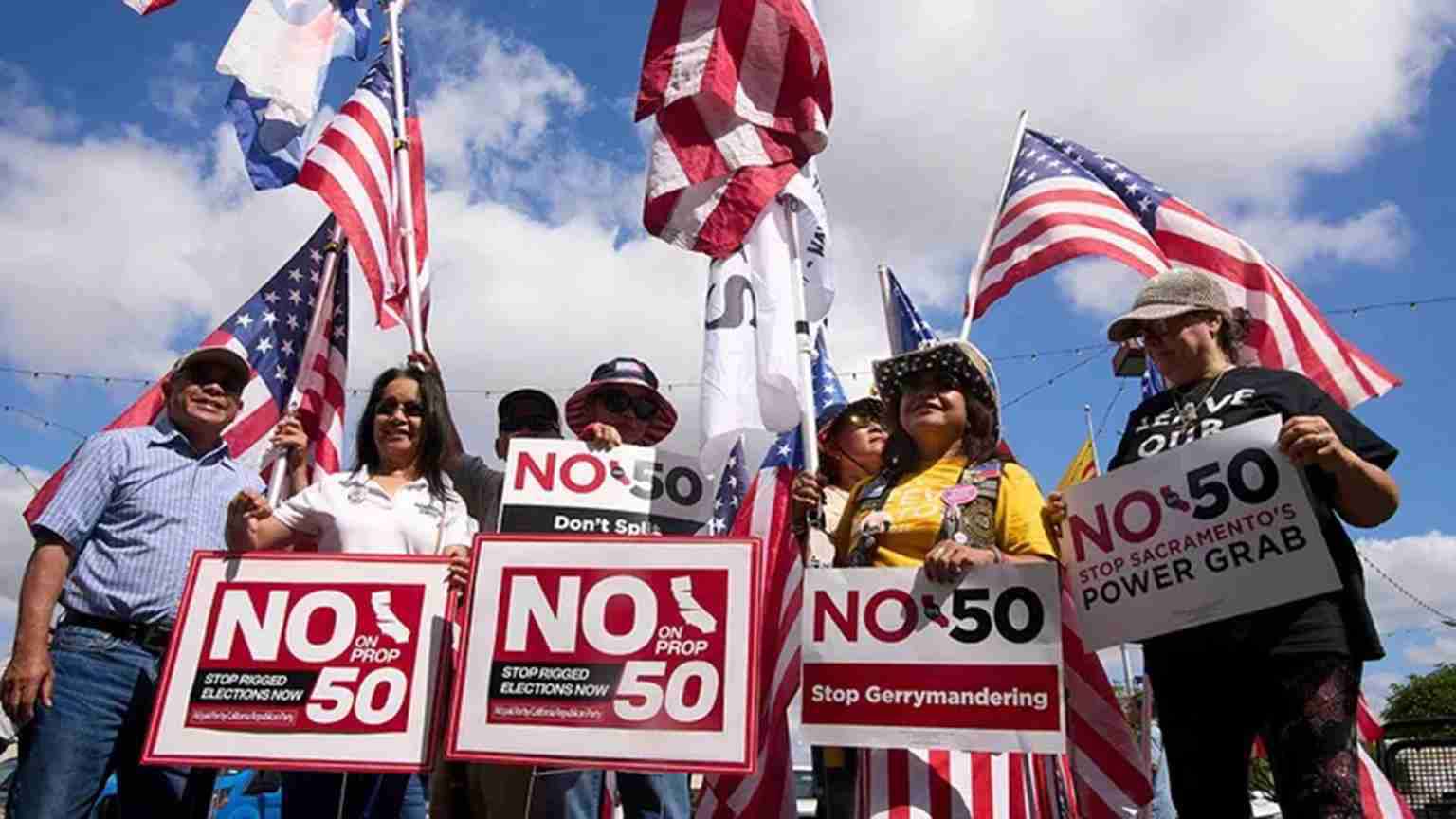
DOJ joins suit against Newsom, says California used race as proxy to draw Democrat-friendly congressional maps
The Department of Justice sued California over its newly approved congressional maps, alleging officials used race as a proxy to create districts advantaging Democrats — a move the DOJ calls unconstitutional racial gerrymandering and a federal overreach.
Key takeaways
- DOJ intervention: The DOJ filed to intervene in litigation challenging California’s new congressional maps after Proposition 50; reporting cited Time.
- Allegation: Federal lawyers say California used racial data as a proxy for partisan advantage, producing lines that favor Democrats and that may violate the Constitution and the Voting Rights Act (reported by UPI).
- Newsom response: Governor Gavin Newsom denounced the DOJ action as politically motivated and pledged to vigorously defend the voter-approved maps (Time).
DOJ files suit and frames its claim
The Department of Justice filed suit Thursday to intervene in litigation over California’s congressional maps approved after voters passed Proposition 50. Federal attorneys say the maps crossed the line into racial gerrymandering by using race to predict voting behavior and shape districts that help one party.
Federal filing (as reported) argues the state relied on racial data not for the constitutionally protected purpose of safeguarding minority voters but to produce partisan outcomes. The DOJ characterizes that practice as using race as a stand-in for politics, which it says violates both the U.S. Constitution and the federal Voting Rights Act (UPI).
What the DOJ says
DOJ attorneys contend the redistricting process treated race as a primary factor. The complaint points to specific elements of mapmaking and the resulting boundaries as evidence that racial considerations predominated over neutral mapmaking goals, a practice courts have found unlawful when race predominates (UPI).
Quote (reported): The DOJ framed its action as protecting constitutional rights and preventing race-based districting that undermines equal voting protections.
What California and Gov. Newsom say
Governor Newsom and state defenders emphasize that the maps were approved by voters via Proposition 50 and were intended to reflect population shifts. Newsom called the DOJ action politically motivated and vowed to defend the maps, arguing changes were about reapportionment and demographic realities rather than entrenching power (Time).
Background: Proposition 50 and the new maps
Proposition 50 passed on Election Day and authorized a pre-election redrawing of California’s congressional maps. Supporters say the measure addressed population shifts and aimed for representative districts; critics warned a pre-election redraw could be used for partisan advantage (Time).
After Prop 50 took effect, the state approved new congressional lines that will shape which voters are grouped together and could influence the partisan balance of California’s delegation (UPI; Time).
Why the legal fight matters
The case probes how much race can factor into redistricting. Courts allow race-conscious mapmaking when necessary to protect minority voting rights, but the law forbids race from being the predominant factor over neutral objectives like compactness, political boundaries, and equal population (UPI).
Federal intervention elevates the dispute: a court siding with the DOJ could force new maps, change California’s political map for 2026 and beyond, and set precedent for other states where race and politics overlap (UPI; Time).
What the complaint alleges — plain terms
Plainly: The DOJ alleges officials used racial demographics to predict political behavior and then drew lines that grouped voters to benefit one party. The suit labels that tactic racial gerrymandering, asserting it violates the Constitution and the Voting Rights Act (UPI).
What we do not yet know
As of the filing, detailed briefs and supporting evidence have not been publicly released. That leaves the public without a full view of the DOJ’s legal theory and California’s forthcoming detailed responses. The state is expected to stress voter approval of Proposition 50 and population-driven map changes (Time).
Broader implications for national politics
Because control of Congress can hinge on a handful of districts, California’s maps matter nationally. A ruling that tightens limits on race-conscious mapmaking could prompt redrafts elsewhere, influence party resource allocation, and sharpen debates in Washington about federal oversight of state redistricting (UPI; Time).
Implications for Las Vegas, Nevada
Economic: Campaign spending, advertising buys and consulting work often cross state lines; changes in California’s maps could shift where political dollars flow, affecting Nevada firms and Las Vegas media markets.
Political: National parties may redirect resources based on California outcomes, altering attention and funding for competitive Nevada races.
Social & cultural: Las Vegas’ diverse electorate may be affected by new legal precedent about race-conscious districting; community groups could adjust strategies for minority representation and voter engagement.
Practical takeaway: Nevada officials, community groups and voters should monitor the case — legal precedent from California could be cited in Nevada litigation or inform local redistricting and ballot measure discussions.
Reporting and sources
This article draws on reporting of the DOJ intervention and Proposition 50 from UPI and Time. Full reporting on the DOJ filing and California’s response is ongoing.
Sources: UPI (DOJ sues California redistricting); Time (Newsom and Proposition 50 background).
Note: All factual details and URLs in this report reflect the original reporting cited above.



