Scientists say mystery solved: Easter Island moai statues “walked” upright, matching Rapa Nui oral traditions
Scientists report the moai of Easter Island were moved upright by a coordinated “walking” motion using ropes and small teams — a method proven in experiments and consistent with long‑held Rapa Nui oral accounts and new archaeological analysis.
- New experiments show life‑size replicas can be “walked” by a small crew, confirming feasibility.
- Physics — statue shape, forward lean and D‑shaped bases produce pendulum‑like dynamics that make walking efficient.
- Labor estimates drop dramatically: many moai could be moved by roughly 15–60 people, not hundreds.
The walking hypothesis and the evidence
Researchers led by Carl P. Lipo and Terry L. Hunt examined 962 moai using 3D models and location maps to test whether the statues were purposely designed for upright transport. Their dataset and analysis are summarized in the SSRN preprint by Carl P. Lipo and Terry L. Hunt and related publications.
Key design features — a forward lean and D‑shaped or flattened bases — create stable pivot points that allow a statue to rock and advance without tipping. These observations were combined with field experiments using a full‑scale replica.
Field experiments: replica tests and results
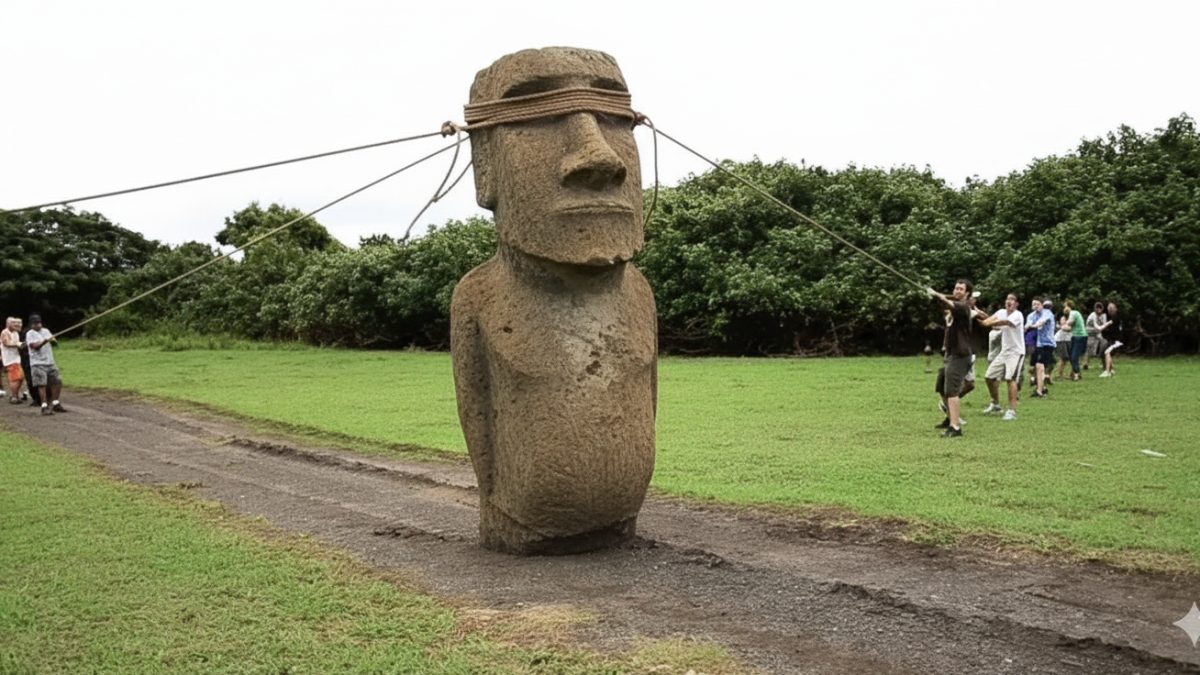
In controlled tests, ropes were attached to each side of a full‑scale replica. Coordinated alternating pulls produced a rocking, step‑like motion. A team of about 18 people moved the replica roughly 328 feet (100 meters) in ~40 minutes, demonstrating sustained movement over distance (Local12 coverage).
Practical result: many statues could be moved with teams as small as 15 people, according to physics estimates and experimental outcomes (Live Science analysis; ScienceDaily release).
Physics and pendulum dynamics
The motion leverages simple mechanics: once rocking begins, forward progress behaves like a pendulum. Alternating tugs on side ropes create controlled rocking and pivoting; momentum reduces the continuous force needed. This makes walking more efficient than dragging flat or rolling on logs.
Researchers measured average step lengths near 35 inches (89 cm), estimating an average moai could move roughly 1,000 feet (310 meters) per hour. A longer transfer (~6.2 miles / 10 km) would need about 11,000 steps, per the study (Live Science analysis).
Labor, efficiency and environmental implications
Because the walking technique dramatically reduces required manpower, the findings challenge prior models that presumed hundreds of workers and extensive tree‑felling to roll statues on logs. The new estimates — often 15–60 people — imply less environmental strain and different social organization for moai transport (ScienceDaily release).
Archaeological context: abandoned statues and roads
Archaeologists have long found moai at various stages—unfinished, toppled, or abandoned along island roads. The research interprets these distributions as consistent with upright transport errors or pauses in the walking process, rather than traces expected from systematic horizontal dragging (University of Arizona experts’ publication).
Cultural alignment: oral tradition validated
For generations, Rapa Nui oral tradition described the moai as having “walked” from the quarry to ahu platforms. The study provides a physical mechanism that aligns with those narratives, underscoring how indigenous knowledge can encode practical engineering solutions (Popular Mechanics).
“An ingenious and worthwhile contribution,” said Sue Hamilton of UCL, praising the combination of archaeological data and physical experiments that make the walking hypothesis archaeologically and physically robust.
Methodology and sources
The research synthesizes a large measurement dataset, 3D modeling, controlled field experiments and physics calculations. Full details are available in the journal article and linked preprints and summaries, notably the SSRN preprint by Carl P. Lipo and Terry L. Hunt and journal publication in the Journal of Archaeological Science.
Implications for Las Vegas, Nevada
The findings present local opportunities for Las Vegas institutions and communities:
- Economic impact: Increased interest in Rapa Nui culture could boost tourism, drive museum exhibits and lecture series that attract visitors and convention attendees.
- Academic ties: Universities such as UNLV could use the case study across anthropology, physics and engineering curricula, fostering public lectures and partnerships with Rapa Nui scholars.
- Cultural sensitivity: Museums and organizers should partner with Rapa Nui representatives to ensure respectful, accurate presentation of cultural materials and oral traditions.
- STEM outreach: Science centers and schools can create hands‑on demonstrations illustrating pendulum dynamics and cooperative problem solving inspired by the moai tests.
- Practical programs: Exhibits, volunteer training, and school field trips can integrate this narrative to enrich local civic programming and tourism offerings.
Sources and further reading
- SSRN preprint by Carl P. Lipo and Terry L. Hunt
- Local12 coverage
- Popular Mechanics
- Fox News travel report
- Live Science analysis
- University of Arizona experts’ publication
- ScienceDaily release
Dateline: Easter Island, Chile (Times Media Service). Parent Publication: Times Media Service.