6-million-year-old ice discovery in Allan Hills, Antarctica, offers a direct window into Earth’s climate history
An international team recovered about 6-million-year-old ice from Allan Hills, East Antarctica, containing trapped air bubbles that provide the oldest directly dated atmospheric samples — offering unprecedented, direct insight into Miocene–Pliocene greenhouse gas levels and long-term Antarctic cooling.
- Oldest directly dated ice: Samples from Allan Hills contain ~6-million-year-old ice and trapped air bubbles — the oldest directly dated atmospheric record yet.
- Direct atmospheric measurements: Trapped gases (including argon isotopes) let scientists date and measure ancient greenhouse gases from the Miocene–Pliocene.
- Long-term Antarctic cooling: Oxygen isotopes point to roughly a 12°C (22°F) long-term cooling across Antarctica over the past 6 million years.
- Snapshot record: The Allan Hills samples provide discrete snapshots up to six times older than prior ice-core records rather than a continuous record.
How the Allan Hills ice discovery was made
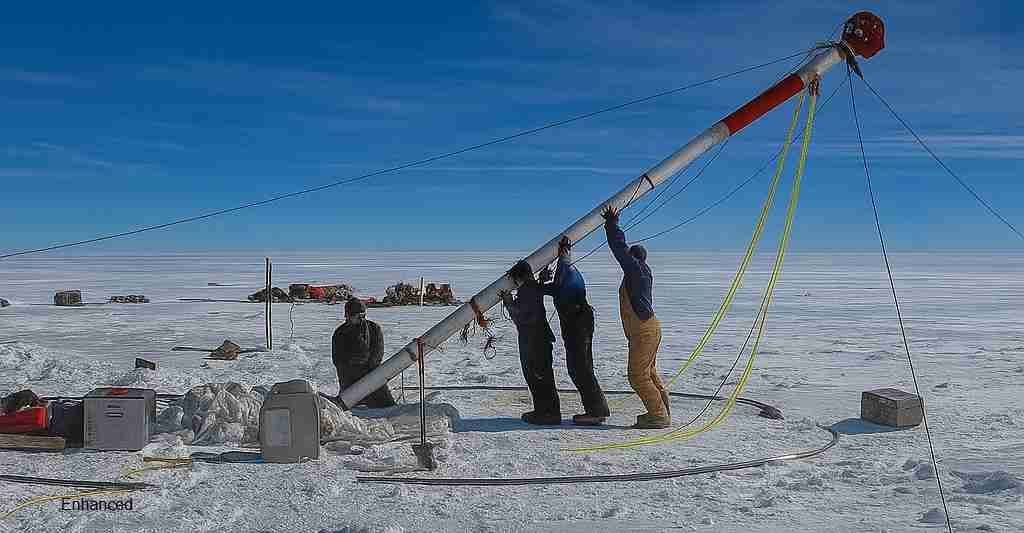
Researchers targeted the Allan Hills region of East Antarctica because its surface patterns and ice flow bring very old ice near the surface. Wind and ablation concentrate ancient layers where teams can sample them without deep drilling, using hand collection and shallow coring tools.
The key advance was dating the air trapped in bubbles. Instead of relying solely on ice composition, teams measured isotopes of noble gases — including argon isotopes — preserved in the bubbles. That approach ties the age directly to the atmosphere itself and reduces uncertainty compared with some earlier, indirect methods.
“Measuring gases inside bubbles provides a clock that is tied to the atmosphere itself,” researchers say, giving a stronger age estimate for the samples.
The work is part of the COLDEX (Center for Oldest Ice Exploration) consortium and involves investigators from institutions including Woods Hole Oceanographic Institution and Princeton University. Results were published in the Proceedings of the National Academy of Sciences (PNAS).
What the ice reveals about Earth’s climate history
The trapped bubbles are miniature time capsules that contain greenhouse gases and snapshots of atmospheric composition from roughly 6 million years ago. Paired with water-isotope chemistry in the ice, these data enable direct reconstructions of temperature and atmospheric conditions during the late Miocene and early Pliocene.
Analyses of oxygen isotopes in the Allan Hills ice indicate a long-term cooling of about 12°C (22°F) across Antarctica over the past 6 million years — one of the first direct ice-based measurements confirming a multi-million-year cooling trend that aligns with geologic evidence of global transition from warmer climates toward the Pleistocene.
Importantly, the record is not continuous; it provides discrete snapshots that extend the temporal reach of ice-based atmospheric sampling up to six times farther back than previous ice-core records. That makes the Allan Hills archive uniquely valuable for direct greenhouse-gas measurements from a climatically important interval.
Why this matters to scientists
Direct atmospheric samples from deep time give researchers new tools to test climate models and hypotheses about ice-sheet sensitivity, greenhouse-gas forcing, and sea-level response under warmer climates. The Allan Hills discovery expands the reach of ice-core science by millions of years, helping compare modern, rapid human-driven warming with natural climate variations of the past.
Potential benefits:
- Better constraints for climate models using direct CO2 and gas measurements from the Miocene–Pliocene.
- Improved understanding of how Antarctic ice sheets behaved under warmer conditions and implications for sea-level projections.
- New empirical data to refine assumptions about climate sensitivity and long-term feedbacks.
Sources, collaboration and the path ahead
The work was carried out by a team that includes the Woods Hole Oceanographic Institution, Princeton University, and multiple partners in the COLDEX consortium. The peer-reviewed results appear in PNAS.
Researchers plan additional field campaigns in Allan Hills and other target sites between 2026 and 2031 to find older ice and bridge gaps between snapshot records. The goal is to build a longer, more detailed archive of ancient atmosphere and climate data.
Questions and limits
Scientists caution against overinterpreting snapshot data. While dating using trapped gases is robust, uncertainties remain and the record’s discontinuous nature requires careful cross-checking with marine and terrestrial archives. Key open questions include regional responses of Antarctic ice sheets during warm intervals and how local changes translate into global sea-level shifts.
Ongoing work will focus on repeated sampling, cross-validation with independent proxies, and integrating these direct atmospheric records into broader paleoclimate frameworks.
Implications for Las Vegas, Nevada
Though the Allan Hills discovery is a deep-time Antarctic record, it has indirect but relevant implications for Las Vegas planners, public-health officials, and researchers:
- Economic and water planning: Improved long-term climate constraints feed models used by water managers and infrastructure planners in Southern Nevada, influencing decisions tied to the Colorado River and drought resilience.
- Heat and public health: Context about past climate sensitivity helps local agencies prepare for hotter summers and more extreme-heat events, even as contemporary warming remains driven by modern greenhouse-gas emissions.
- Urban planning and resilience: Better constraints on climate sensitivity and sea-level projections inform energy demand, emergency response planning, and long-range utility and infrastructure investments.
- Migration and economic ripple effects: Understanding past sea-level behavior helps federal and state planners consider scenarios that could influence coastal disruptions, migration patterns, and federal investments affecting Nevada.
- Education and research ties: The discovery offers a vivid story for museums, universities, and schools, and may spur local research partnerships applying updated climate model outputs to regional risk assessments.
Sources and further reading
- Woods Hole Oceanographic Institution: Six-million-year-old ice discovered in Antarctica offers unprecedented window into a warmer Earth
- Proceedings of the National Academy of Sciences (PNAS) paper
- University of Maine climate summary
- IFLScience summary
Reporting compiled from Times Media Service with material from the cited research organizations.