Newsom’s high‑speed rail humiliation deepens as transport chief admits mistakes and $126B price tag draws “Stonehenge” jeers
California’s high-speed rail project, approved in 2008 for $33 billion, now faces a projected $126 billion price tag, major funding gaps, federal grant rescissions and admitted mismanagement — turning the promised LA–SF link into a political liability.
Key takeaways
- Voters approved the project in 2008 at an advertised $33 billion and a sub‑three‑hour LA–SF promise (YouTube video).
- Projected cost for the full line is now about $126 billion by 2026, leaving roughly a $90 billion funding gap (YouTube video; Senate Commerce report).
- Central Valley work (Merced–Bakersfield) is the only visible progress, but opening could be delayed to 2033 and the full system remains unfunded (Senate Commerce report).
- Federal rescissions removed roughly $4–$4.2 billion in grants after reviewers found no viable path to earlier timelines (U.S. DOT op‑ed).
From promise to problem: the timeline and rising tab
When voters approved Proposition 1A in 2008, they were shown a sleek plan: high‑speed trains connecting San Francisco and Los Angeles in under three hours for roughly $33 billion. Today, state and federal reviews put the cost to finish the full LOS ANGELES–SAN FRANCISCO line at about $126 billion — nearly four times the original estimate (YouTube video; Senate Commerce report).
Most construction to date is confined to the Central Valley. That 171‑mile Merced–Bakersfield segment is the only portion where riders might realistically see tracks and trains in the next decade, but even it faces delays and uncertainty after federal reviewers concluded earlier timelines were not feasible, prompting withdrawal of billions in federal grants (Senate Commerce report; U.S. DOT op‑ed).
State admissions and political fallout
California Transportation Secretary Toks Omishakin publicly acknowledged mistakes and said criticism was “very fair,” admitting, I don’t think the voters fully understood and neither did we what it was gonna take to actually get this project delivered.
He added that the state still intends to find funds to finish the work (YouTube video).
Gov. Gavin Newsom scaled back the project years earlier, saying in 2019, “Right now, there simply isn’t a path from San Francisco to LA,” and shifted focus to the Central Valley — a move critics say abandoned the core promise made to voters (YouTube video).
Republican lawmakers used the failures to argue the project is emblematic of waste. Rep. Vince Fong labeled it “a complete bait and switch,” while other critics, including Rep. Kevin Kiley and Sen. Ted Cruz, blasted the project for taking decades and billions with few results (Senate Commerce report; YouTube video).
Federal actions and a strained partnership
The federal government’s role turned contentious when the U.S. Department of Transportation under Secretary Sean Duffy rescinded roughly $4–$4.2 billion in grants after reviews found the project was not on track to meet earlier federal milestones. Duffy called the program a “train to nowhere” and said billions had been spent without delivering an operating system (U.S. DOT op‑ed).
California sued the federal government in response, calling the rescissions “petty retribution.” The state later withdrew the suit and moved to proceed with state and other funding sources, underscoring how fragile large infrastructure partnerships can be (U.S. DOT op‑ed).
Local impressions: “Stonehenge” and political theater
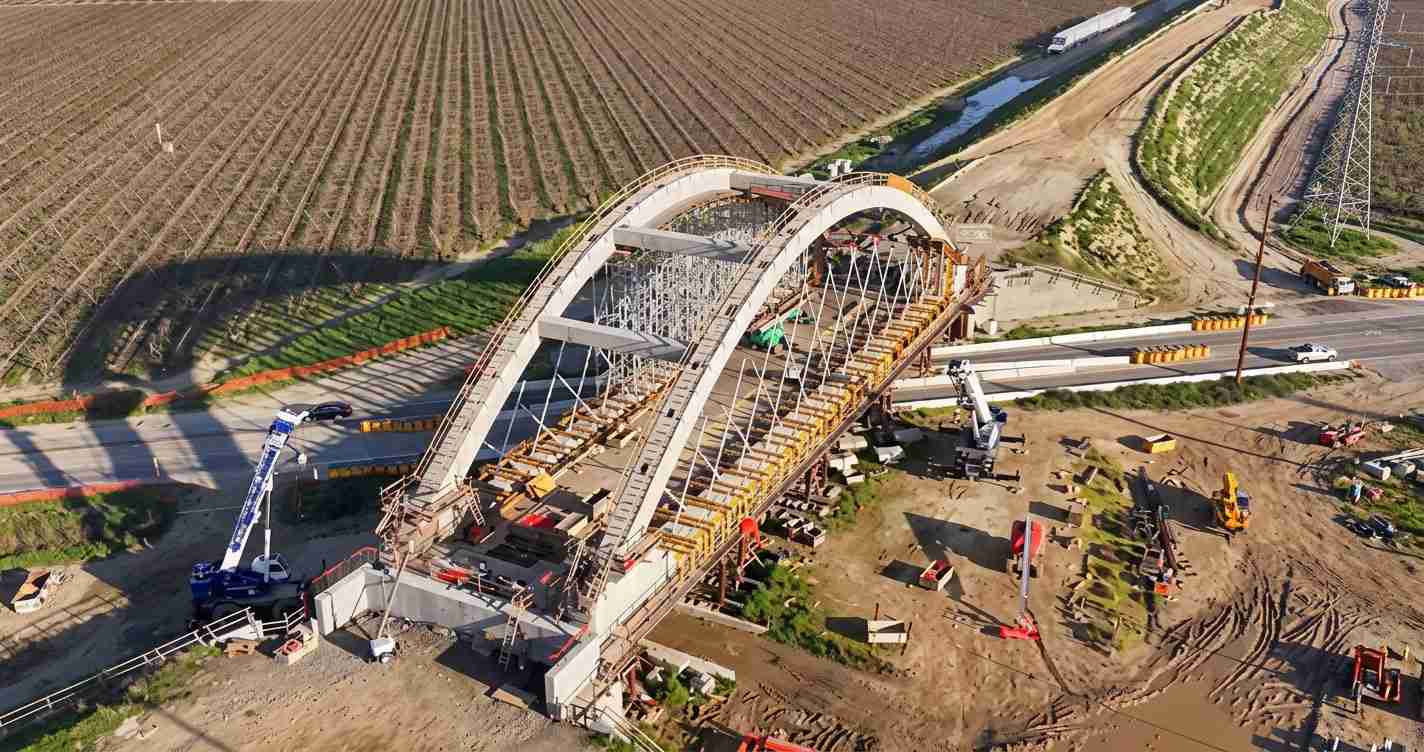
On the ground in the Central Valley, the project is visible mainly as concrete piers and incomplete viaducts. In Fresno, locals mock those structures as “Stonehenge,” a nickname capturing both the scale of unfinished work and public skepticism. What was sold as a modern transit artery, to many, now looks like monuments to delay and cost overruns (YouTube video).
Investigations and transparency concerns
The project has attracted probes and controversy: state investigators examined the rail authority’s CEO amid arrest reports and conflict concerns. At the same time, bills pushed by Gov. Newsom in 2026 sought to exempt some inspector general records from public disclosure, prompting warnings that the move could create a “veil of secrecy” over oversight documents. Transparency advocates argue open records are essential when billions in public money are at stake (YouTube video; CalMatters; CapRadio).
Cost context: a massive price tag
The revised estimate — $126 billion — dwarfs the original $33 billion figure presented to voters in 2008. The new total exceeds the amount Amtrak has ever received from the federal government since 1971, a comparison noted in recent reviews. State officials admit the full amount to finish the project is not on hand today but maintain it may be possible to secure future funding (YouTube video; Senate Commerce report).
Why the Central Valley?
After funding and route setbacks, state leaders focused on the Central Valley as the most feasible starting point. But the Valley is not the dense corridor the original plan targeted; ridership estimates there are lower, raising questions about whether completing only the Central Valley segment will ever generate enough revenue or ridership to justify the entire system (YouTube video).
Implications for Las Vegas, Nevada
California’s high-cost, troubled project has several implications for Nevada and Las Vegas-area leaders:
- Economic competition for federal funds: The $126 billion estimate and funding shortfall may shift federal priorities and increase competition for grants that Nevada relies on (U.S. DOT op‑ed; Senate Commerce report).
- Regional tourism and travel: A stalled California rail reduces prospects for easy rail links to Nevada, potentially keeping more visitors arriving by car or plane and affecting airports and congestion.
- Political and fiscal lessons: Nevada officials may cite the California case as a cautionary tale for tighter estimates, stronger oversight and clearer contingency plans (CalMatters; CapRadio).
- Workforce and supply chain impacts: Contractors and suppliers might redirect efforts to Nevada projects if California funding gaps persist — an economic opportunity that depends on Nevada’s ability to secure funding and permits.
- Public trust and voter sentiment: Voters watching the saga may become more skeptical of ballot measures and large infrastructure promises lacking staged funding and strong oversight.
Reporting and sources
Reporting for this story included official statements and public record reviews from the U.S. Department of Transportation and congressional committees, public remarks by state officials, and news reports. Key sources cited in this article:
- YouTube: YouTube video (WgUYXpZ5zuw)
- YouTube: YouTube video (HNGacGd4uxQ)
- YouTube: YouTube video (VSD5OwJkT8s)
- U.S. Department of Transportation: DOT briefing/op‑ed
- U.S. Senate Commerce Committee: Senate Commerce report
- CalMatters: CalMatters reporting
- CapRadio: CapRadio reporting