Sperm Whales’ Calls Found to Resemble Human Vowels, UC Berkeley and Project CETI Say
UC Berkeley and Project CETI researchers report sperm whale vocal sequences include slow acoustic modulations resembling basic human vowels, based on machine-learning analysis of decades of Dominica recordings—a finding that reframes views of cetacean communication and conservation.
Key takeaways
- Linguistic framing: A UC Berkeley-led team under Gašper Beguš shows sperm whale “codas” contain slow acoustic modulations that resemble human vowel patterns, challenging the view that whale clicks are only Morse-like pulses (UC Berkeley news release).
- Machine learning: Project CETI’s AI tools find whale clicks in noisy recordings with ~99.5% accuracy, separate click patterns with ~97.5% accuracy, and detect dialect differences with ~95.3% accuracy, enabling fine-grained analysis.
- Long-term recordings: The work uses decades of acoustic and behavioral data from a well-studied sperm whale population off Dominica collected by Project CETI.
- Conservation link: Evidence of structured, possibly symbolic signals strengthens scientific and policy arguments for greater protections and funding for whale conservation.
How the study was done
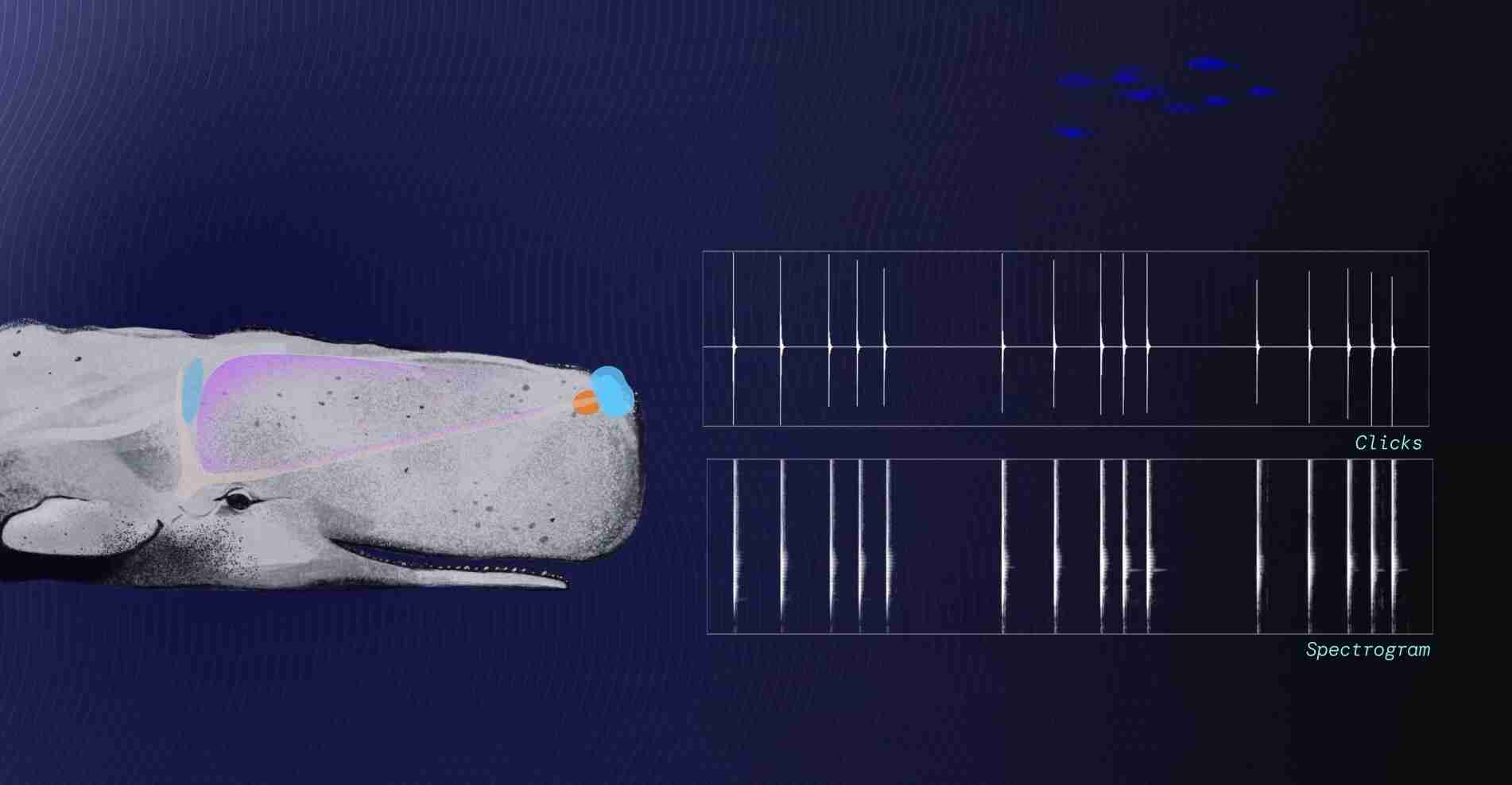
Field recordings + computation + linguistics. Researchers combined long-term field recordings from Dominica with computer models and formal linguistic methods. Rather than treating whale codas as isolated pulses, the team analyzed them as continuous acoustic signals, looking for slow modulations analogous to how human vocal tracts shape vowels.
Project CETI’s dataset includes years of synchronized acoustic and behavioral data from a well-studied sperm whale population. Using those recordings, the team applied machine-learning tools to extract clicks from noisy ocean environments, classify click patterns, and identify dialect-like differences across groups.
Method highlight: treating codas as continuous acoustic events revealed steady spectral and temporal modulations that align with concepts used in human phonetics to describe vowels.
Machine learning and accuracy
Machine learning enabled detection and classification at scale. According to summaries of Project CETI’s work, their algorithms can identify whale clicks with approximately 99.5% accuracy, separate many click patterns with approximately 97.5% accuracy, and distinguish dialect differences with approximately 95.3% accuracy (Project CETI on the Audacious Project).
What the vowel-like sounds mean
Not human language—but structure matters. The discovery does not imply sperm whales speak English or any human tongue. Instead, the presence of slow, steady acoustic modulations suggests codas may contain richer, continuous features that could support structured social signals, complex meanings, or cultural transmission within groups.
Sperm whales live in tight family groups, possess large brains, and rely on sound for navigation, hunting, and social interaction. If codas carry vowel-like structure, that may help explain how whales coordinate, maintain social networks, and pass knowledge across generations.
Project CETI and the aim to decode another species’ language
Project CETI assembles linguistics, machine learning, and robotics to build a blueprint of nonhuman communication systems. The goal is to map whale vocalizations to behavior and context so scientists can begin to interpret potential meanings. The initiative links scientific inquiry with explicit conservation aims: demonstrating communication complexity can influence public opinion and policy.
The UC Berkeley study contributes rigorous linguistic framing while cautioning against anthropomorphism; lead researcher Gašper Beguš and collaborators emphasize reproducible methods, more field work, and data sharing to validate and deepen the findings (UC Berkeley news release, Project CETI).
Why this matters for science and policy
If sperm whale vocalizations include language-like structure, assumptions about animal cognition and communication must be reassessed. The results join other findings of complex signaling in parrots, dolphins, and certain primates.
Policy implications include potential strengthening of legal protections, increased funding for habitat preservation, and stricter controls on noisy shipping or deep-sea activities. Project CETI’s conservation-linked mission explicitly ties the scientific case to advocacy and funding priorities (Project CETI; Audacious Project summary).
What remains unknown
Limits of the current evidence: vowel-like acoustic patterns are only one component of human language. This study does not demonstrate syntax, grammar, or symbolic reference. Key open questions include whether whale sounds map reliably to objects, actions, or social roles, and whether combinations of patterns can carry complex meanings.
A major gap is context: linking sounds to meaning requires detailed, synchronized behavioral records at the moment of vocalization. Project CETI’s long-term efforts in Dominica are assembling such contextual datasets, but more field data and analysis are required.
Implications for Las Vegas, Nevada
Though landlocked, Las Vegas can still benefit from and contribute to work on whale communication through education, museums, philanthropy, and civic engagement. The study offers avenues for local universities, cultural institutions, and donors to engage with marine science and AI.
Economic and educational opportunities
Local institutions—such as the University of Nevada, Las Vegas, and community colleges—can create coursework and projects in linguistics, computer science, and biology that use Project CETI datasets. Museums and convention venues could host exhibits, talks, or conferences linking whales, AI, and conservation.
Conservation and policy engagement
Nevada’s philanthropic community and local nonprofits could fund marine research and awareness campaigns. Evidence of structured whale communication may strengthen fundraising appeals and advocacy to protect whales globally (Project CETI).
Civic and cultural relevance
The intersection of machine learning and animal intelligence may resonate with Las Vegas audiences who follow tech and entertainment trends. Media outlets and public programs can run special features, school partnerships, and forums on interspecies communication and ethics.
Practical effects on local life
Growing interest in marine conservation could influence tourism preferences and programming. Hotels, tour operators, and cultural venues might incorporate conservation messaging or sponsor interactive exhibits, while schools can add STEM outreach tied to whale research.
Next steps for Las Vegas organizations
- Higher education: UNLV and community colleges could develop joint courses or remote labs using Project CETI datasets for hands-on machine-learning projects.
- Museums and events: Planetariums and science centers could host temporary exhibits or speaker series on whale communication and AI.
- Conservation outreach: Local nonprofits might partner with national marine groups to fund awareness campaigns or adopt-a-whale programs connecting donors to Dominica research.
Sources and data access
Primary sources and further reading:
- UC Berkeley news release on the study
- Project CETI home page and research overview
- Project CETI on the Audacious Project (machine learning accuracy and goals)
Further reporting will be needed to track how Project CETI’s datasets and UC Berkeley’s linguistic analyses evolve and whether the wider scientific community reaches consensus on how closely nonhuman communication maps to elements of human language systems.