Trump says Americans may soon pay no income tax as White House eyes tariff revenue funding in sweeping US tax system overhaul
President Donald Trump proposed eliminating the federal income tax, claiming tariff revenue could fully fund government operations, potentially ending income tax within a few years — a sweeping, contentious overhaul facing major legal, economic and political hurdles.
Key takeaways
- Tariff funding claim: Trump said Americans “won’t even have income tax to pay” because tariffs are bringing in revenue he described as “literally trillions of dollars.” (Fox Business, CPA Practice Advisor)
- Timeline and flexibility: Trump suggested changes could occur “over the next two, three, four years” but left open keeping a much lower income tax rate (CPA Practice Advisor).
- Cautious Treasury stance: Treasury Secretary Scott Bessent favors tariff-driven income tax relief and targeted exemptions rather than immediate full repeal (CPA Practice Advisor).
Main content
Trump’s comments and timeline
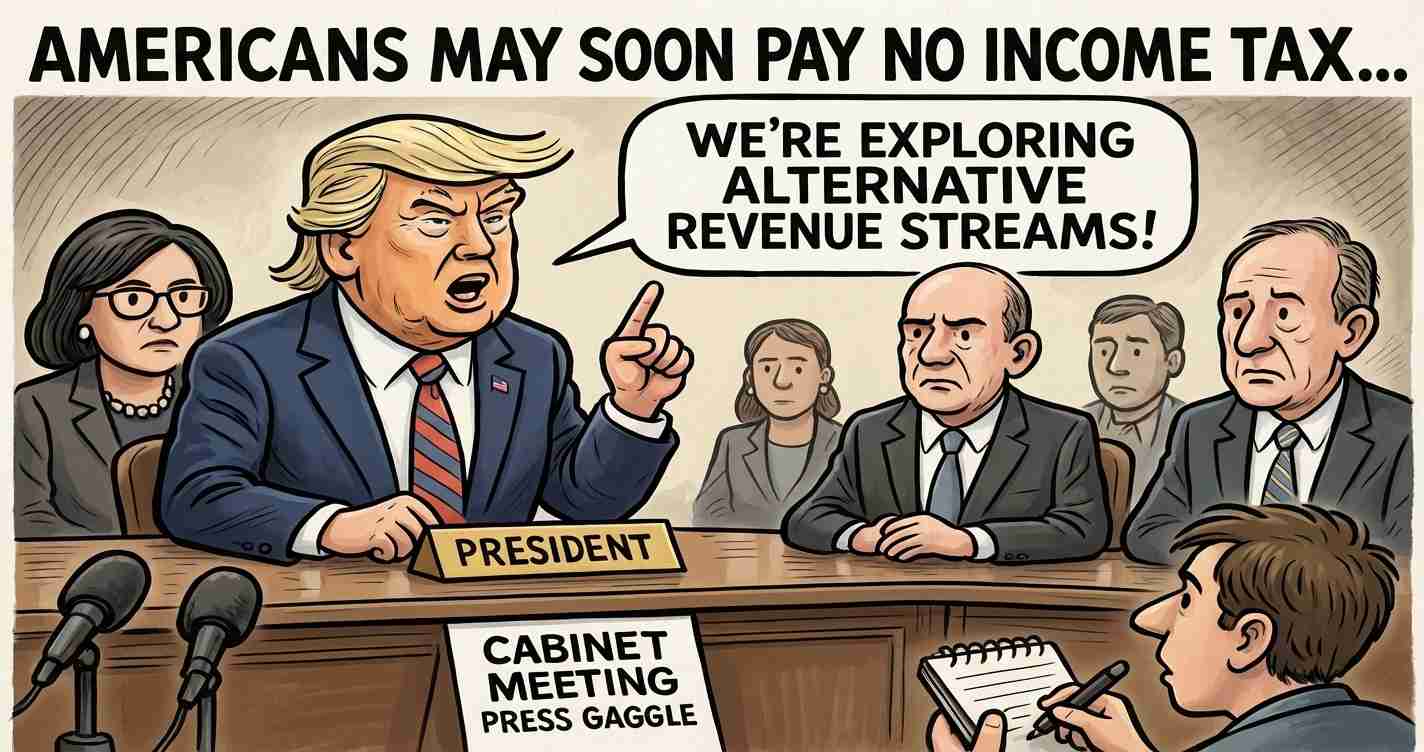
During a December 2 Cabinet meeting press gaggle, Trump told reporters income taxes could vanish in the “not-too-distant future” because tariff collections are so large. He said the government might be “giving back refunds out of the tariffs” and predicted a time when people would no longer “be paying income tax.” For reporting and context see CPA Practice Advisor.
“We’re taking in literally trillions of dollars,” Trump said, adding that Americans “won’t even have income tax to pay.”
White House aides and the Treasury
Treasury Secretary Scott Bessent has presented a more cautious framing, endorsing tariff-funded income tax relief and selective exemptions — for example, on tips, Social Security benefits and overtime pay — rather than a full repeal. The Treasury’s public stance emphasizes phased or targeted measures funded in part by tariffs (CPA Practice Advisor).
Policy evolution and prior proposals
This is not the first time Trump has floated tariff-driven tax changes. Earlier in his second term he proposed eliminating income tax for individuals earning under $150,000 and replacing that revenue with tariffs. His recent remarks are the most explicit endorsement yet of a full or near-full transition to tariff revenue — reporting by Fox Business documents the administration’s exploration.
How big a change would this be?
Federal income tax currently supplies roughly 54% of total federal revenue. Replacing that share solely with tariffs would require collecting more than half of the federal government’s annual receipts through import taxes — the largest overhaul of the U.S. tax system in over a century, with comprehensive legal, budgetary and entitlement implications.
Economic and political obstacles
Officials and analysts note steep tests: Congress must pass major legislation to rewrite tax rules, and a narrow House majority complicates any sweeping swap. Economists warn that relying on tariffs at the scale described is unproven and risky, potentially raising consumer prices and inviting trade retaliation (Fox Business).
Tariffs as a revenue source: pros and cons
- Cons: Tariffs are often passed to consumers as higher prices, can be regressive, may distort supply chains, and risk retaliation from trading partners.
- Pros: Supporters say tariffs can protect domestic industry and generate predictable revenue — though the administration’s claim of “trillions” raises questions about sustainability and distributional effects (CPA Practice Advisor).
Budget and entitlement implications
Eliminating the income tax would change how programs are funded. Payroll taxes, corporate taxes and other levies currently support Social Security, Medicare and many federal operations. A tariff-centric model must replace general revenue and entitlement funding streams; Treasury officials have discussed targeted relief, but no detailed, long-term funding plan has been released.
Legislative strategy and public reaction
Republican leaders who favor tariff tools may embrace parts of the idea, while conservative free-market advocates and Democrats are likely to resist. Translating rhetoric into law would require unusually broad consensus; observers say such alignment is unlikely in the near term (Fox Business).
What proponents say
Proponents frame the plan as a simplification that could return more money to Americans while boosting domestic industry. They point to tariff collections as a means to fund broad tax relief and argue targeted exemptions can protect vulnerable groups.
What critics say
Critics — including economists and trade experts — warn that heavy tariffs are regressive and could raise costs for lower- and middle-income households. They caution that tariff revenues are volatile and that large-scale tariff reliance could strain trade ties and harm exporters.
Implications for Las Vegas, Nevada
Economic impact
Las Vegas depends on tourism, hospitality and many imported goods. Higher import costs could increase expenses for hotels, restaurants and casinos, potentially raising prices for visitors and residents. Any take-home pay gains from lower income taxes might be offset by higher everyday costs.
Jobs and business
The service-sector workforce would see mixed effects: dampened discretionary spending could reduce local demand, while onshoring or protected domestic suppliers might benefit local industries. Casinos that import specialized equipment could face particularly sharp cost increases.
Local government and services
Nevada and Clark County budgets could face uncertainty if federal revenue becomes more volatile. Grants for workforce training, public health and transportation might fluctuate, forcing local planners to adapt budgets and priorities.
Political and social consequences
Las Vegas’ competitive political environment means local officials will be pressed to explain impacts on jobs, prices and services. Many families operating on tight budgets could be most affected if price increases outpace income tax savings. Targeted exemptions (for tips, Social Security) may help some service workers.
Practical day-to-day concerns
Residents and small businesses will need clear guidance on paychecks, deductions, business expenses and pricing for imported goods. Local financial advisors, chambers of commerce and nonprofits will likely increase outreach to help households and businesses plan for potential transitions.
Sources and reporting
This article draws on White House statements and reporting on the December 2, 2025 Cabinet meeting. See reporting by Fox Business and an analysis from CPA Practice Advisor. Additional reporting will follow as the administration releases plans and lawmakers respond.