
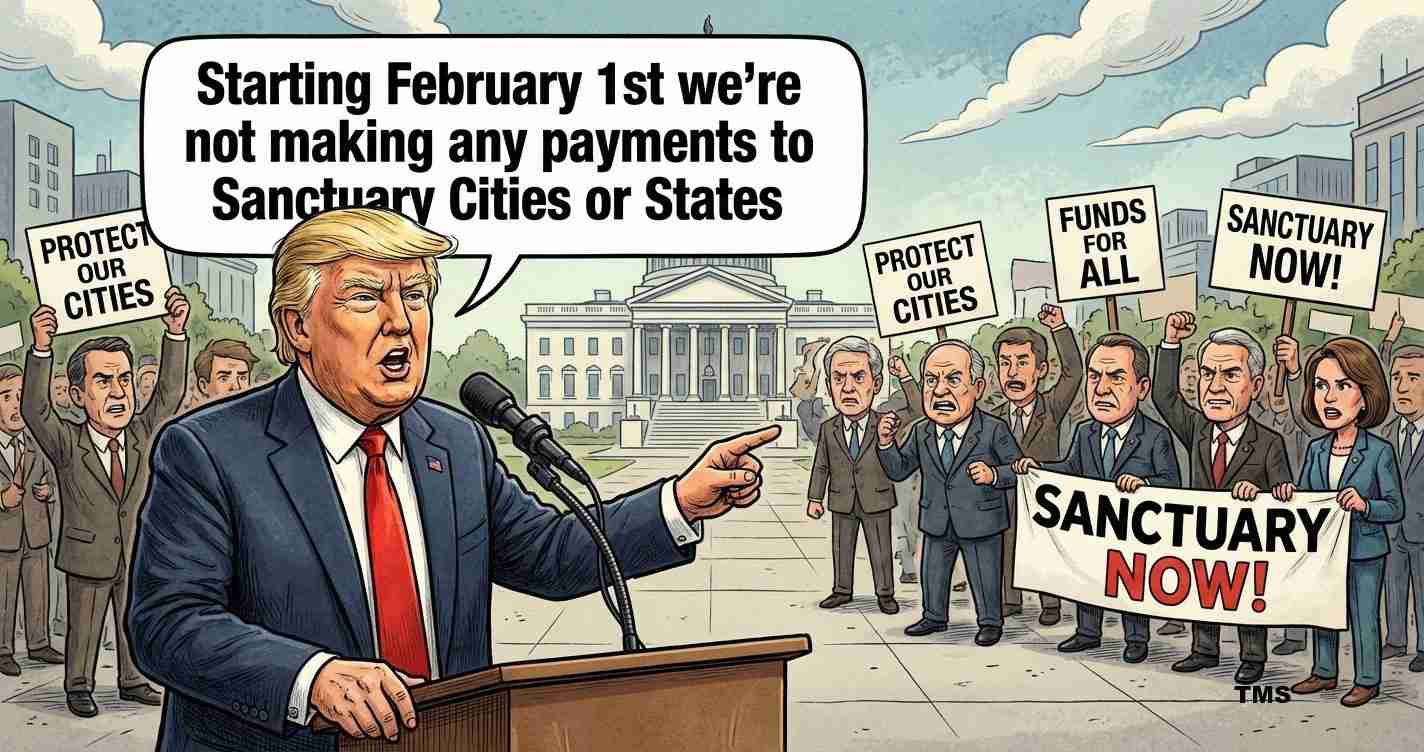
Trump says federal payments to sanctuary cities, states will stop Feb. 1; administration points to fraud, accuses Minnesota leaders
President Donald Trump announced on January 13, 2026, his administration will stop federal payments to sanctuary cities and states beginning February 1, accusing them of protecting criminals and fostering fraud and crime amid legal challenges from affected jurisdictions.
Key takeaways
- Federal halt announced: Trump said payments to sanctuary cities/states will cease Feb. 1, alleging they “protect criminals” and “breed fraud and crime.” KrCR‑TV
- HHS suspensions: Health and Human Services has paused funds tied to child care and other programs in five states amid fraud probes. Fox News
- Court intervention: A federal judge issued a temporary order blocking HHS from carrying out the funding halt on Jan. 9 while the matter is briefed. Fox News
- Legal and local stakes: States and cities say the executive lacks authority to unilaterally cut many grants; expect more lawsuits and local planning. ABC7
Main story
Detroit speech and the new directive
Speaking at the Detroit Economic Club on Jan. 13, Trump outlined a hard-line position tying sanctuary policies to public-safety and fraud concerns. He said,
“Starting Feb. 1, we’re not making any payments to sanctuary cities or states having sanctuary cities because they do everything possible to protect criminals at the expense of American citizens… And it breeds fraud and crime…”
The remarks framed a broad directive to stop federal payments to jurisdictions the administration deems noncompliant. KrCR‑TV
HHS actions cited by the administration
Administration officials pointed to recent steps by the Department of Health and Human Services, which has paused certain funds amid fraud probes tied to child care and other assistance programs. HHS Deputy Secretary Jim O’Neill said families deserve confidence that federal resources are used lawfully and that pausing payments is part of protecting taxpayer dollars. Fox News
Minnesota allegations and the “Minnesota Child Care Fraud” claims
Trump singled out Minnesota, saying the administration “suspended payments tied to suspected scammers in Minnesota, of which there are many,” and criticized Gov. Tim Walz directly, calling him “stupid” and accusing state leadership of tolerating corruption. The specific HHS withholding that included Minnesota involved federal child care funds and related programs; the administration says evidence of misuse justifies pauses while investigations proceed. Minnesota officials have pushed back and signaled they will challenge the moves in court. KrCR‑TV Fox News
Legal fights and past enforcement attempts
This administration’s push echoes earlier efforts to deny funds to jurisdictions labeled “sanctuary.” The Department of Homeland Security previously identified more than 500 noncompliant jurisdictions, and the Justice Department has filed suits against cities and states including Los Angeles, Chicago, Newark, Hoboken, Jersey City, Paterson (N.J.), Rochester (N.Y.), and states such as Illinois, Colorado and New York. Courts have often intervened: federal judges in past years blocked similar cuts for legal or procedural reasons. On Jan. 9, U.S. District Judge Arun Subramanian issued a short-term order freezing HHS’s pause so the parties can brief the court; the order did not resolve the underlying question of executive authority. KrCR‑TV KATV Fox News
What the administration has not yet detailed
Key practical questions remain unanswered. Public statements and available agency documents do not list a full inventory of payments slated for cut on Feb. 1, nor do they explain the precise legal mechanisms beyond the earlier HHS actions. It is unclear whether cuts would target discrete grants, formula payments, or other funding streams, or whether funds would be redirected. KrCR‑TV
States’ response and the fight over authority
States and cities targeted by the administration argue the federal government lacks legal authority to withhold funds solely over sanctuary policies. Many grants are governed by statutes and Congressional appropriations, they say, and unilateral executive action may violate those laws. Legal experts note disputes will hinge on statutory text, grant conditions, and constitutional limits on executive power — and they expect additional litigation from affected jurisdictions. ABC7 Fox News
Background: program types named by HHS
HHS identified specific programs where it paused funds for review: the Child Care and Development Fund, Temporary Assistance for Needy Families (TANF), and the Social Services Block Grant. These streams support child care subsidies, cash assistance, and a range of social services for low-income families — pauses could affect providers and beneficiaries if prolonged. Fox News
Implications for Las Vegas, Nevada
Economic impact: Las Vegas and Clark County receive federal funds for child care, social services and workforce programs that support low- and moderate-income families. Prolonged pauses or expanded withholding could create cash-flow problems for providers and delay reimbursements, raising costs for families and potentially limiting workforce participation in hospitality and gaming.
Political consequences: Nevada’s political mix makes this a likely campaign and policy issue. Local officials may need to defend fund management, prepare for litigation, or negotiate with agencies.
Social effects: Pauses in TANF or social services block grants could reduce wraparound supports, affecting housing, food security, and employment assistance for vulnerable residents.
Practical advice: Clark County and city governments should review grant inventories, confirm at‑risk programs, and communicate contingency plans. Families and providers should monitor local agency notices and consider temporary funding options. Fox News
Reporting and next steps
Affected states have signaled continued legal challenges. Courts are likely to determine whether the administration can implement a broad halt tied to sanctuary policies. Local officials and service providers should watch for agency guidance from HHS, DHS and DOJ and for court rulings that will shape implementation of any announced cuts. KrCR‑TV Fox News



