Trump pledges one‑year, 10% interest cap on credit cards; experts warn of legal hurdles and fallout
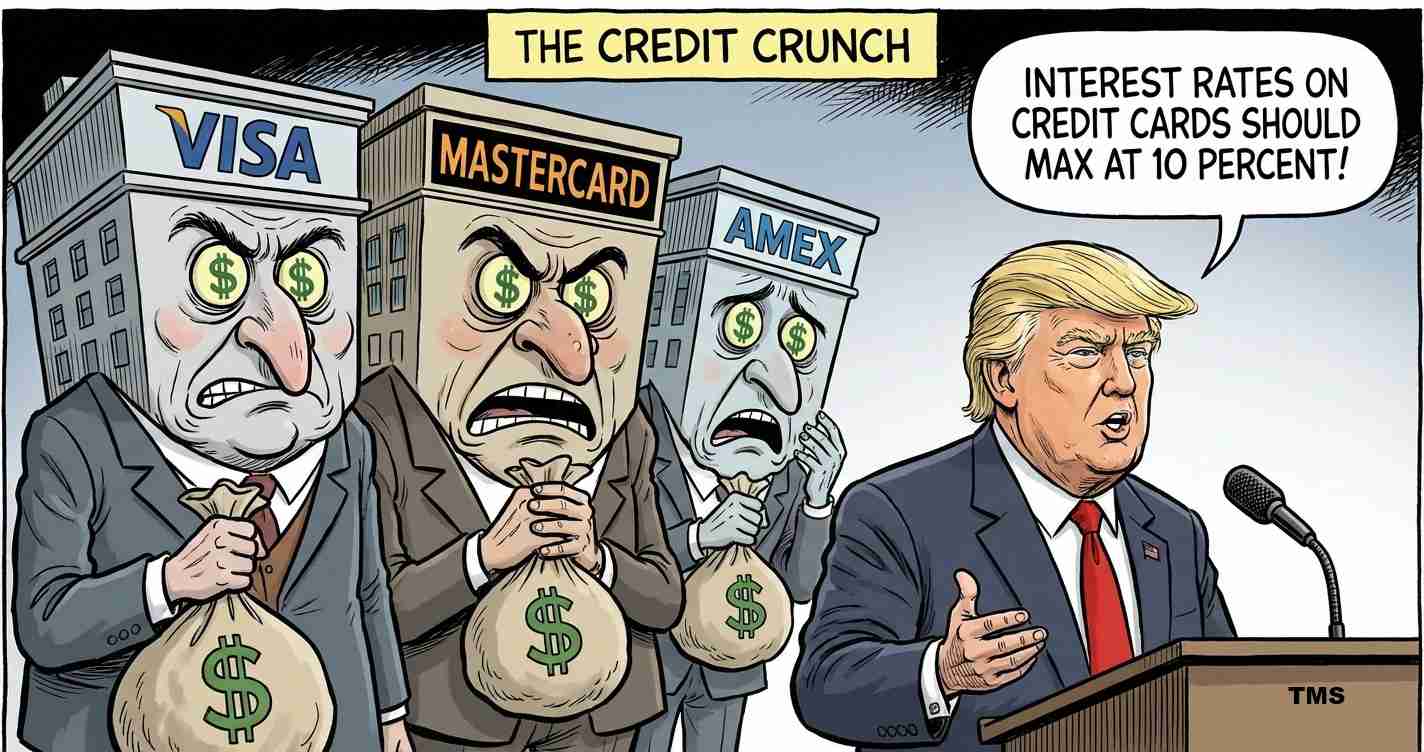
Donald Trump vowed a one‑year, 10% cap on credit‑card interest starting Jan. 20, 2026, if elected, calling it consumer protection on Truth Social; experts say legal and economic hurdles make implementation uncertain and warn of possible tightened credit access.
Key takeaways
- Campaign pledge: Trump called for a one‑year, 10% nationwide cap on credit‑card APRs starting Jan. 20, 2026, via Truth Social.
- Legal limits: Experts say a president likely cannot unilaterally impose such a cap without Congress, regulators or issuer cooperation.
- Economic trade‑offs: Industry groups warn the cap could shrink credit access, cancel accounts and push borrowers to riskier lenders.
- Public support: Polling suggests broad consumer appetite for rate caps despite potential reductions in rewards or access.
Trump’s announcement and wording
On Truth Social, Mr. Trump framed the move as protection for consumers: “We will no longer let the American Public be ‘ripped off’ by Credit Card Companies that are charging Interest Rates of 20 to 30%, and even more, which festered unimpeded during the Sleepy Joe Biden Administration,” and added, “Effective January 20, 2026, I, as President of the United States, am calling for a one year cap on Credit Card Interest Rates of 10%.”
Initial coverage of the post is available from outlets including Fox Business and Business Insider.
Current credit card rate environment
Credit card APRs have climbed alongside higher benchmark rates; Federal Reserve data and reporting show average card APRs above 20% as of early 2026. Typical ranges cited: about 17.7% for excellent credit to near 36% for poor credit — making a 10% cap dramatically lower than current pricing.
Reporting on prevailing rates and ranges can be found via CBS News and Morningstar (MarketWatch).
Legal and practical feasibility
Key legal limit: Constitutional and statutory constraints mean a president generally cannot unilaterally set nationwide private‑sector interest‑rate caps. Implementing a 10% cap would likely require new legislation, use of specific regulatory authority, or voluntary issuer cooperation — each path is complex and uncertain.
Analysts describe the announcement as a political pledge rather than a concrete legal blueprint; past congressional proposals to cap card APRs (some near 18%) failed to become law, underscoring steep legislative barriers. See analysis at Business Insider and Politico.
Industry and expert reaction
Banking trade groups, card issuers and payments coalitions pushed back quickly. America’s Credit Unions warned a 10% cap “does not make credit more affordable, it makes it unattainable for millions of working Americans.” The Electronic Payments Coalition and the Consumer Bankers Association argued a blanket cap could shrink consumer options and restrict access.
Analysts cited by Morningstar suggested a strict 10% cap could remove access from a large share of existing accounts — estimates cited in coverage suggested up to 88% of open accounts might lose access under some scenarios. Hedge‑fund voices warned of account cancellations and migration to unregulated lenders. (See reporting: CBS News; Morningstar.)
Public opinion
Polling and surveys show strong consumer support for rate caps. A LendingTree survey cited in coverage found roughly two‑thirds of cardholders support a cap on credit‑card rates, and about six in ten would still back a cap even after learning it might reduce rewards or restrict access. That combination — vigorous public backing paired with expert warnings about trade‑offs — frames the political challenge ahead.
Comparisons and existing caps
Some targeted protections already exist: the Military Lending Act caps many loans to active‑duty service members at 36% APR, and several states maintain narrower usury limits for certain loan types. But national bank preemption and the lack of a broad federal consumer credit cap mean a 10% nationwide ceiling would be historically sweeping and face legal resistance. (See Politico.)
Unanswered questions
The announcement leaves many practical details unclear: would store cards, small‑dollar products, subprime borrowers or certain issuer classes be exempt? Would the cap be phased in, and how would enforcement work across banks, fintechs and credit unions? No detailed implementation plan has been released by the campaign or major issuers.
Those gaps open a wide range of outcomes — from limited voluntary industry rate cuts to sustained legal fights and tightened credit access. Initial reporting frames this as a political headline more than an executed policy at this stage. (Coverage includes Fox Business and Business Insider.)
Implications for Las Vegas, Nevada
Economic impact: Las Vegas’s service‑driven economy — with many workers in hospitality, retail and entertainment — could see immediate relief for households that carry card balances if APRs drop. Yet issuer responses such as pulling credit lines or canceling accounts could remove emergency credit for workers with irregular incomes.
Political consequences: Local voters and leaders may judge the proposal by tangible effects on bills and access. Nevada’s congressional delegation and local officials would be central if Congress or regulators become involved.
Social and cultural effects: Because many residents rely on cards to bridge irregular pay cycles or cover medical and housing costs, changes in card availability could ripple into household stability, small‑business cash flow and local spending patterns.
Practical applications for residents
- Check rates: Cardholders should review APRs and balances now and consider alternatives like balance transfers or personal loans if rates fall.
- Monitor accounts: Consumers with thin credit histories should watch issuer communications in case accounts are closed or credit limits lowered.
- Small businesses: Merchants may see changes in merchant fees or payment terms if issuers and processors react to new rules or market shifts.
Bottom line
The political headline is simple: Mr. Trump is calling for a one‑year, 10% cap on credit‑card interest starting Jan. 20, 2026. The legal, economic and implementation details are far more complex — and whether such a cap would deliver consumer relief or shrink credit access will depend on Congress, regulators and private issuers.