Federal appeals court ends SAVE plan — 7 million borrowers face shifting student loan repayment options after ruling
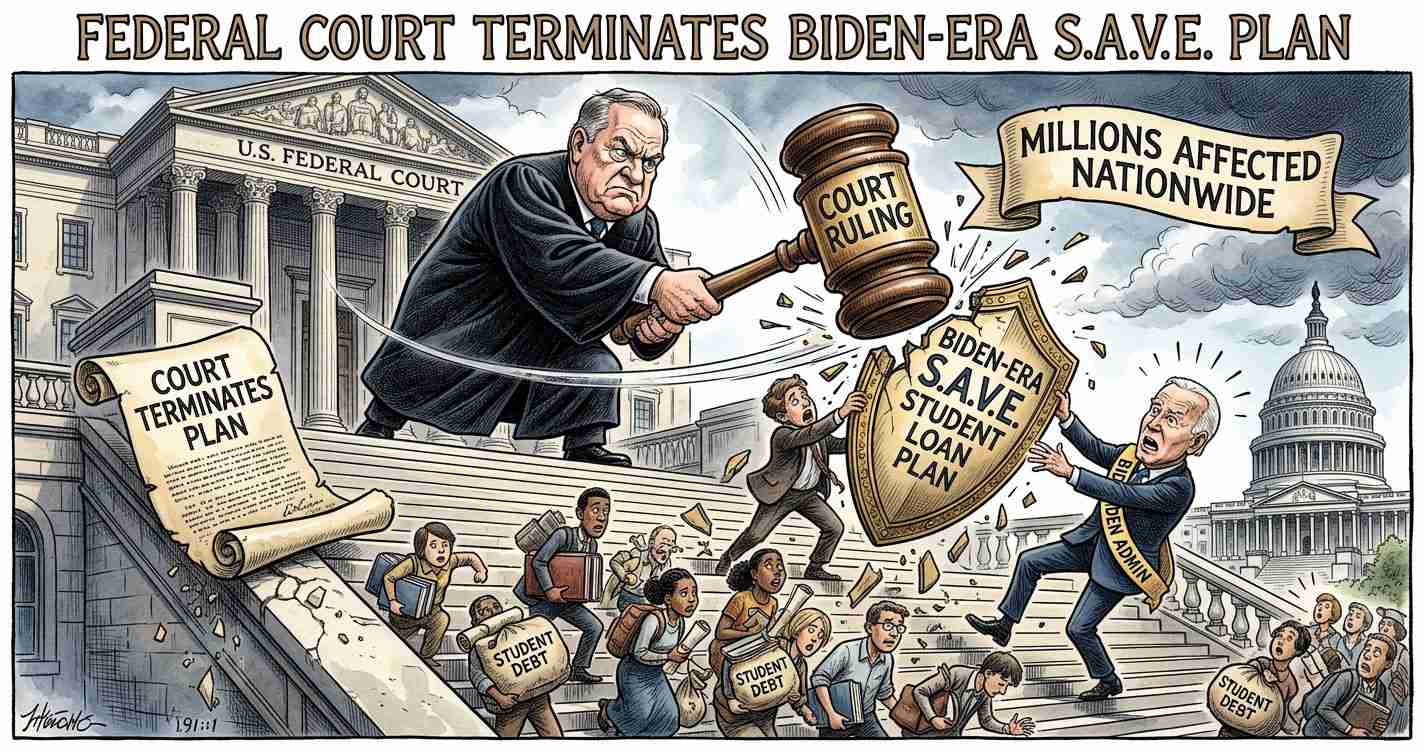
A federal appeals court on March 9, 2026, ended the SAVE student loan repayment plan, forcing more than 7 million borrowers to move into alternatives such as IBR or the new RAP, raising monthly-payment and forgiveness uncertainties.
Key takeaways
- The SAVE plan was ended by an appeals court on March 9, 2026 — see the SAVE plan officially ended by court order.
- More than 7 million borrowers are enrolled in SAVE and will be shifted to other repayment options — read the TICAS briefing on the end of SAVE.
- Alternatives include IBR, the new RAP under OBBBA, or standard plans — details are available in the Financial Aid updates.
- The Department of Education will begin outreach but has not provided firm timelines — further context in the TICAS analysis.
Federal appeals court ruling
On March 9, 2026, the U.S. Court of Appeals for the Eighth Circuit reversed a February ruling by Judge John Ross and allowed a Republican-led legal challenge to proceed. The appeals decision effectively ends the SAVE plan before its previously scheduled 2028 wind-down and permits the Department of Education to stop accepting new enrollees and to begin moving current borrowers into other repayment programs. See reporting on the SAVE plan officially ended by court order and analysis from TICAS.
Background on SAVE
Introduced in 2023 under President Joe Biden, the SAVE (Saving on a Valuable Education) plan was promoted as a major overhaul of income-driven repayment. Advocates called it the “most affordable repayment plan ever created” because it subsidized unpaid monthly interest in many cases, preventing balances from growing and setting payments as low as 1% of AGI for some borrowers, with a cap of 10% and a flat $10 monthly option for very low earners. SAVE quickly became the largest income-driven option in use — more background in the TICAS briefing.
Impact on current borrowers
As of Q4 2025, more than 7 million borrowers were enrolled in SAVE, with roughly 450,000 additional borrowers expressing interest. Under the court-approved framework, the Department will:
- Stop taking new SAVE applications and deny pending applications.
- Require current SAVE borrowers to be moved into alternative repayment plans, which may raise monthly payments for many who benefited from SAVE’s interest subsidies.
The Department of Education has committed to negotiated rulemaking and outreach to affected borrowers, but it has not provided clear deadlines or completed the technical fixes needed to move millions without disruption. Advocates warn that switching this many accounts could cause billing gaps, missed credit toward forgiveness, and long customer-service delays — see the TICAS analysis.
Student loan repayment options after SAVE
Borrowers displaced from SAVE will face a mix of older and newer repayment choices. Key options include:
- Income-Based Repayment (IBR): For older loans, IBR sets payments at 10%–15% of discretionary income over 20–25 years. IBR will remain available for loans disbursed before July 1, 2026, but it is scheduled to sunset by July 1, 2028.
- Repayment Assistance Plan (RAP): Created under the One Big Beautiful Bill Act (OBBBA) and effective July 1, 2026, RAP uses a sliding scale from 1% to 10% of AGI but requires 30 years of payments for forgiveness and will be the only income-driven option for loans disbursed after July 1, 2026.
- Standard Repayment Plan: Fixed monthly payments over 10–25 years depending on loan size and type; some borrowers may land here by default if they do not choose an alternative.
Note: While RAP may resemble SAVE in payment scaling, it lacks SAVE’s interest subsidies and requires a longer payment period for forgiveness; IBR may suit some older borrowers but is being phased out for newer loans.
Transition timeline and implementation challenges
The Department faces substantial technical and administrative hurdles. System updates for IBR enrollment are incomplete, and RAP’s rulemaking and infrastructure are not finalized. Planned changes for December 2025 were not completed, leaving uncertainty about when borrowers can enroll in alternatives without service interruptions.
Nearly half of borrowers report long waits to reach servicers, and some applications have taken more than six months to process. Those backlogs raise the risk of billing errors, delays in restoring credit for forgiveness programs, and abrupt payment increases. Advocates outline these concerns in the TICAS analysis.
Public Service Loan Forgiveness and tax implications
Borrowers pursuing Public Service Loan Forgiveness (PSLF) should act quickly. Some who were making progress under SAVE may be entitled to have months recredited if SAVE progress was frozen during litigation or administrative changes. The Education Department advises borrowers to verify PSLF status and file applications to reclaim qualifying months; see guidance from TICAS.
Tax treatment of forgiven debt changed: the American Rescue Plan’s tax exemption for forgiven student loan debt expired at the end of 2025, so forgiveness is taxable again starting in 2026 unless Congress acts, potentially increasing the financial burden for those expecting forgiveness — further context in the Financial Aid updates.
What borrowers should do now
Immediate steps for borrowers:
- Check your loan servicer account for messages and updated billing notices.
- Review enrollment options and deadlines when the Department issues details.
- If pursuing PSLF, confirm qualifying employment and submit the PSLF form to preserve credit for past payments.
- Compare projected monthly payments under IBR, RAP, and standard plans to understand budget impacts.
- Keep detailed records of payments and communications with servicers to document any errors or delays.
Full guidance remains limited until the Department completes rulemaking and system changes. Borrowers can begin by reviewing official resources and advocacy trackers such as TICAS and the College Investor report.
Implications for Las Vegas, Nevada
Economic impact: Las Vegas’ large population of renters, service workers, and hospitality employees often carry student debt. Higher monthly payments could reduce household disposable income and pinch local consumer spending — especially in neighborhoods with younger adults and recent graduates.
Political consequences: Student loan policy is a hot-button issue in Nevada; local officials and candidates may face pressure to press federal authorities for transitional relief or state assistance.
Social effects: Increased payments could widen financial stress, raise nonpayment risks, and lead to long-term credit impacts. Community nonprofits and legal aid groups may see more requests for counseling and repayment help.
Cultural relevance: Many Las Vegas public-facing workers value PSLF; clear guidance on reclaiming PSLF credit will be important to retain employees in schools, city departments, and nonprofits.
Practical steps for local borrowers:
- Contact your loan servicer and local nonprofit financial counselors.
- Attend community information sessions hosted by Nevada Higher Education or legal aid groups.
- Verify PSLF employment and submit PSLF forms to protect months of credit while the Department sorts the transition.
For more information and tracking
Key resources and trackers:
- TICAS: Department of Education announces end of SAVE plan
- The College Investor: SAVE plan officially ended
- Financial Aid updates: federal loan changes beginning in 2026
“Borrowers should prepare now by checking servicer notices, documenting communications, and verifying PSLF credit while federal agencies complete rulemaking and technical fixes.”