Athletics Las Vegas Stadium ground broken: “We are Vegas’ team” as Armadillo Ballpark Design rises from dirt
The Oakland Athletics held a ceremonial groundbreaking Monday for a $1.75 billion, 33,000-seat Las Vegas ballpark at the Tropicana site, with owner John Fisher declaring, “We are Vegas’ team,” as construction aims for a 2028 opening.
Key takeaways
- Major milestone: Groundbreaking begins construction on a $1.75 billion, 33,000-seat stadium the team expects to open in 2028 (ESPN).
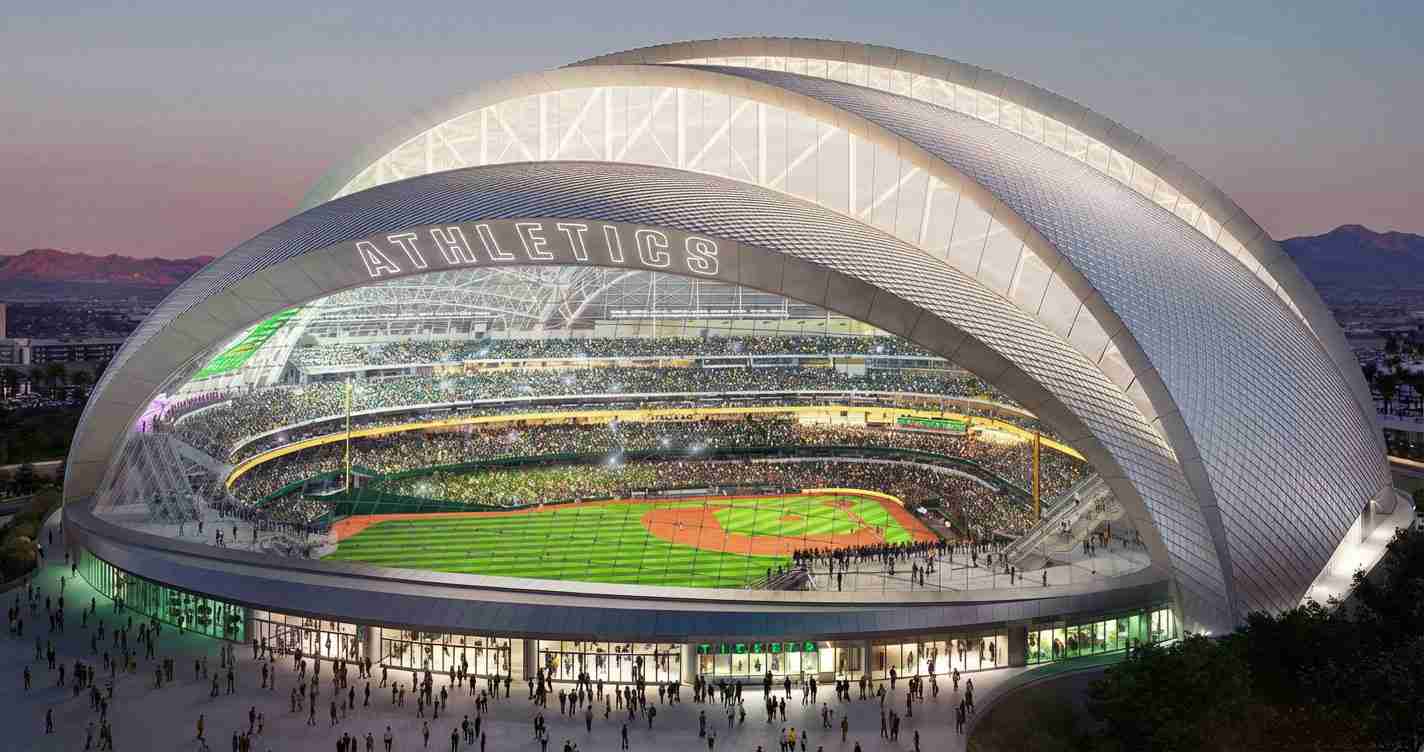
- Distinct design: Danish firm BIG’s overlapping, shell-like volumes — nicknamed the Armadillo Ballpark Design — define the stadium’s look (Dezeen).
- Public support: Nevada and Clark County approved up to $380 million in tax credits and a special tax district to support the project (Review-Journal).
Project overview: site, size and public support
The ballpark will occupy nine acres of a larger 35-acre Bally’s Strip parcel at Tropicana Avenue and Las Vegas Boulevard, where the former Tropicana towers were demolished to clear the site. Developers plan a larger mixed-use redevelopment that includes a planned 3,005-room Bally’s hotel surrounding the stadium (Review-Journal; Dezeen).
Capacity and seating: The stadium will seat 33,000, with approximately 84% of seats between the foul poles to keep fans close to the action (ESPN).
Public financing: Nevada and Clark County authorized up to $380 million in tax credits and created a special tax district; the enabling bill passed in 2023, and those measures form part of the project’s public support framework (ESPN; Review-Journal).
Design and architecture: the “Armadillo Ballpark Design”
Danish architecture firm BIG (Bjarke Ingels Group) conceived the stadium as five overlapping, wedge-shaped arched volumes that nod to baseball pennants and the desert landscape. The overlapping metal shells have prompted media and local outlets to call it the Armadillo Ballpark Design because the enclosure resembles an armadillo’s armor (Dezeen).
BIG’s plans feature a sweeping cable-net glass entrance wall — rendered at roughly 36,000 square feet — and domed lounges and concession areas tucked behind curved metal shells. Early designs removed a retractable outfield wall in favor of an enclosed, climate-aware venue. Key consulting firms include HNTB, Thornton Tomasetti and Henderson Engineers (Dezeen; Review-Journal).
Construction progress and timeline report
Status updates: Team president Marc Badain reported accelerated concrete deck pours. The first deck pour is in the outfield; the second-level concourse over the lower concourse has been poured from the third-base foul pole toward first base. About half of the stadium decks had been poured as of midweek updates (ESPN; Review-Journal).
Upcoming milestones: Badain said steel work in the bowl will start in March; the fifth of six buttresses supporting the roof was due by month’s end with the sixth planned for spring. Roof steel is expected by June with major framing forming through summer and early fall; escalators were due onsite within weeks (ESPN; Review-Journal).
Completed early work: Zoning and land-use approvals were finalized April 2, 2025; grading began April 22, 2025; and caissons for the foundation were drilled May 13, 2025. Those steps set the stage for the ceremonial groundbreaking and heavier construction now underway (Review-Journal).
Relocation timeline and approvals
The A’s relocation process spanned multiple years after stalled Oakland talks in 2021. Discussions and community planning in Las Vegas accelerated in 2023 with the Tropicana site deal and passage of Nevada’s SB1 funding. By late 2024 the team had finalized lease and non-relocation agreements and secured MLB owners’ approval; meanwhile the franchise staged home games at a temporary Triple-A park in West Sacramento while the new Las Vegas stadium is built (Review-Journal; Wikipedia).
Voices at the groundbreaking
The ceremony included MLB Commissioner Rob Manfred, state and local leaders, former A’s stars such as Rollie Fingers and Dave Stewart, Little Leaguers and many local figures. Manfred highlighted Las Vegas’ favorable demographics and tourism market. Owner John Fisher emphasized youth outreach:
“If you can get the kids, you can get their parents.”
(ESPN).
Investigative note on financing and public backing
The deal includes up to $380 million in public assistance through state tax credits and a special tax district. Supporters cite job creation, tourism revenue and long-term tax benefits; critics point to opportunity costs and risks tied to public subsidies for private stadiums. Team and state officials assert the package supports broader site redevelopment and hotel expansion (ESPN; Review-Journal).
Team and community context in Las Vegas
The A’s will be Las Vegas’ fourth major professional franchise, joining the Raiders, Golden Knights and Aces. The move ends Oakland’s MLB tenure and creates pressure to build local roots quickly. The organization is pursuing local partnerships, youth programs and visible branding; this season they wore a sleeve patch linking Sacramento’s Tower Bridge with Las Vegas as part of a sponsorship program (ESPN).
Implications for Las Vegas, Nevada
Economic impact
- Jobs and construction: The project promises construction employment immediately and permanent jobs in operations, concessions and hotel services later; developers say local workers will build the ballpark (Review-Journal; ESPN).
- Tourism and hotel lift: The planned Bally’s hotel expansion and stadium are pitched to extend visitor stays and boost local spending (Dezeen; Review-Journal).
Political consequences
Public funding remains under scrutiny. Supporters cite economic models and redevelopment benefits; opponents note competing needs such as schools, roads and housing. The stadium’s fiscal outcomes will shape political discourse in the years ahead (ESPN; Review-Journal).
Social effects
Fisher emphasized youth outreach at the ceremony; the team plans programs to build fans among children. Accessibility of ticket pricing and the scope of community benefits remain important local questions to monitor (ESPN).
Cultural relevance
The Armadillo Ballpark Design may become a new Strip landmark: a visually distinctive venue that blends spectacle with civic identity. Some residents, however, question how the stadium will integrate with life near Tropicana and Dean Martin Drive (Dezeen; Review-Journal).
Practical applications for residents
- Traffic and transit: Game days will add pressure to Strip traffic; planners will need coordinated parking, ride-hail zones and potential transit service to limit disruption.
- Neighborhood change: Redevelopment can raise property values and spur new businesses — bringing jobs but also the risk of higher rents; officials say they will monitor impacts and seek community benefits.
Reporting notes and next milestones
Watch for these construction indicators: the start of steel work in the bowl (March), completion of the fifth and sixth roof buttresses, visible roof steel by June, and major framing in summer and early fall. Escalator deliveries and installations are imminent; those milestones will indicate progress toward the 2028 opening goal (ESPN; Review-Journal).
Sources
Sources cited in reporting: ESPN, Review-Journal, Dezeen, Wikipedia.
Full links:
https://www.espn.com/mlb/story/_/id/45570507/athletics-celebrate-groundbreaking-175b-vegas-stadium
https://www.reviewjournal.com/sports/athletics/as-las-vegas-ballpark-timeline-how-mlb-team-arrived-at-groundbreaking-day-3388252/
https://www.dezeen.com/2025/06/25/big-las-vegas-armadillo-stadium-the-athletics-ground-breaking/
https://en.wikipedia.org/wiki/New_Las_Vegas_Stadium