
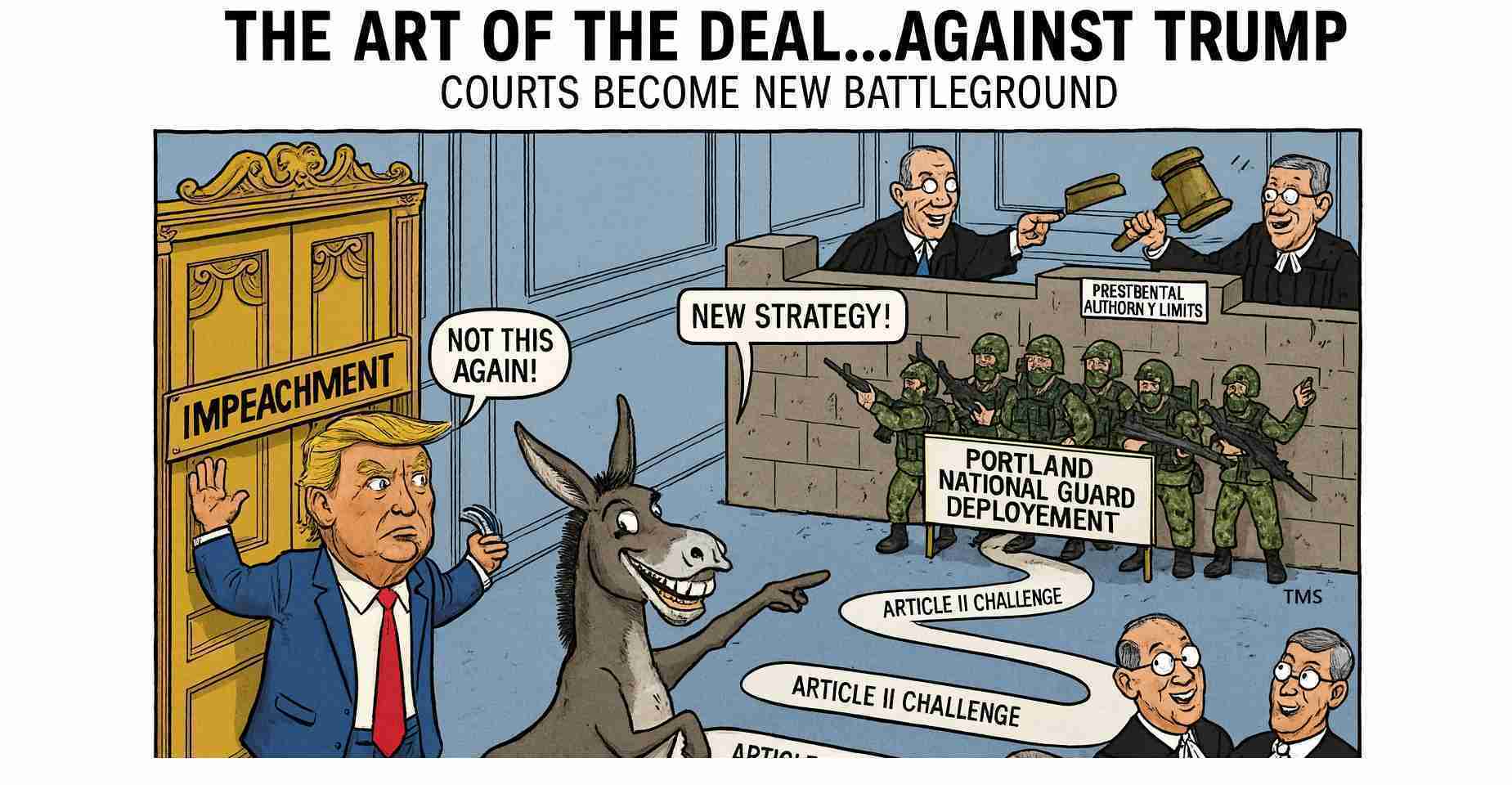
Democrats Turn to Article II Constitutional Challenges to Curb Trump — Portland National Guard Deployment Becomes Latest Court Test
WASHINGTON (Times Media Service) – Democratic lawmakers and advocacy groups are increasingly turning to Article II constitutional challenges and federal courts — exemplified by the Portland National Guard deployment — to constrain President Trump’s executive authority and redefine separation-of-powers oversight through emergency injunctions.
- Strategic shift: Democrats now favor court challenges under Article II over impeachment to seek immediate, enforceable limits on presidential actions (The Regulatory Review).
- Portland test: The National Guard deployment to Portland is a central case testing whether federal troop movements into states exceed the President’s power or infringe state authority (Just Security).
- Active judiciary: Federal courts are increasingly issuing injunctions or blocks against executive actions, signaling robust judicial policing of presidential limits (Callabor Law).
Legal strategy shifts from impeachment to Article II challenges
After high-profile impeachment efforts, many Democrats and allied groups say the courts offer a more immediate and enforceable path to check presidential actions. Rather than pursue removal proceedings that require congressional consensus, litigants are filing narrow suits under Article II to argue that specific orders or deployments exceed constitutional authority. Legal trackers show a surge in these cases, reflecting a deliberate change in tactics designed to force courts to define the limits of executive action (Just Security).
What Article II challenges look like
Article II challenges usually take the form of lawsuits asking federal judges to halt actions or declare them unlawful. Plaintiffs range from state officials to civil-rights groups. Courts hear requests for emergency injunctions and temporary restraining orders aimed at stopping a specific action now and creating precedents for future cases. Lawyers emphasize these suits test both statutory rules and constitutional separation-of-powers lines (The Regulatory Review).
Portland National Guard deployment as a test case
The deployment of federal forces, including the National Guard, to Portland has become one of the most visible flashpoints. Plaintiffs contend the deployment violated the Tenth Amendment and other federal laws by interfering with state authority and local policing decisions. Courts are weighing whether the President can send troops into states without clear statutory justification or adequate legal grounding; rulings could set major precedents about federal intervention in state affairs (Just Security, The Regulatory Review).
Judicial record and recent trends
Federal judges have not been passive. Over recent months, courts have temporarily blocked or limited enforcement of several executive actions — including high-profile orders on diversity and other policies — signaling that judicial review remains an active check on presidential directives. Legal advocates point to more than 100 lawsuits and dozens of restraining orders filed against the administration as evidence that the courts are central to resolving these policy disputes (Just Security; Callabor Law).
High court views and the separation-of-powers debate
Some Supreme Court opinions have been read as endorsing broad executive authority — the notion that the President wields the “entirety of the executive power.” Scholars warn that an expanded view of that power could weaken Congress’s ability to check the executive. That concern fuels current litigation: Democrats and advocacy groups argue vigorous court challenges are necessary to preserve separation of powers and prevent executive overreach (The Regulatory Review; Center for American Progress).
Perspectives from both sides
Administration supporters say quick court challenges are politically motivated and risk hamstringing the executive, arguing the President must retain latitude for swift action on national security and public order. Opponents counter that unchecked executive power can endanger civil liberties and erode democratic norms. Constitutional experts note repeated court battles may be required to clarify legal lines left unresolved by legislation and politics (The Regulatory Review; Center for American Progress).
How courts shape policy in real time
By granting or denying injunctions, federal judges can pause a federal action while legal questions are decided, making litigation a tool for immediate oversight rather than only a route to final rulings. For lawmakers and advocacy groups without the votes to remove a president, courtrooms have become an alternative arena to demand accountability (Just Security).
Implications for Las Vegas, Nevada
Economic impact: Las Vegas depends on conventions, tourism and large gatherings. A federal-state clash over troop deployments or federal interventions at protests could scare visitors, force event cancellations and impose sudden security costs on casinos and hotels.
Political consequences: Nevada officials may be drawn into legal fights or public disputes with the federal government. Federal court rulings on deployments and presidential power will shape coordination between state and federal agencies during emergencies and could become campaign issues.
Social effects: Residents are sensitive to public-safety and civil-rights concerns. Court decisions expanding or limiting federal authority to deploy troops will affect protest policing and large-event security; community groups and business associations may file amici briefs or form coalitions to press local positions.
Cultural relevance: Las Vegas markets itself as an open, diverse city. Perceptions that federal forces could police local protests may clash with local values on free expression and economic openness, affecting cultural institutions and promoters.
Practical applications for residents: Changes to federal deployment rules could alter emergency responses to wildfires, floods or public-health crises. Constraints on federal assistance might slow aid unless state consent is given; conversely, expanded federal authority could speed support but raise oversight concerns.
What local leaders can do
Nevada and Las Vegas officials can prepare by reviewing emergency agreements with federal partners and clarifying National Guard activation protocols. Local elected officials, legal teams and community groups should coordinate positions if national rulings affect Nevada. Clear public communication about authority in crises will reduce confusion and maintain trust.
Ongoing stakes
As the Portland case and other Article II challenges proceed, judges will set legal boundaries with nationwide effects. For urban voters who favor practical solutions, these court battles offer a legal path to test presidential power while avoiding the political gridlock of impeachment. Litigation will continue to shape both national policy and local life in places like Las Vegas (Just Security; The Regulatory Review; Callabor Law; Center for American Progress).
Sources
- The Regulatory Review: Spotlight — The uncertain future of the separation of powers
- Just Security: Tracker — Litigation and legal challenges to the Trump administration
- Callabor Law: Federal court temporarily blocks enforcement of anti–DEI executive orders
- Center for American Progress: The president and constitutional violations — will the federal courts contain power grabs?



