Trump announces 100% additional tariff on China as Beijing expands controls on rare earth minerals
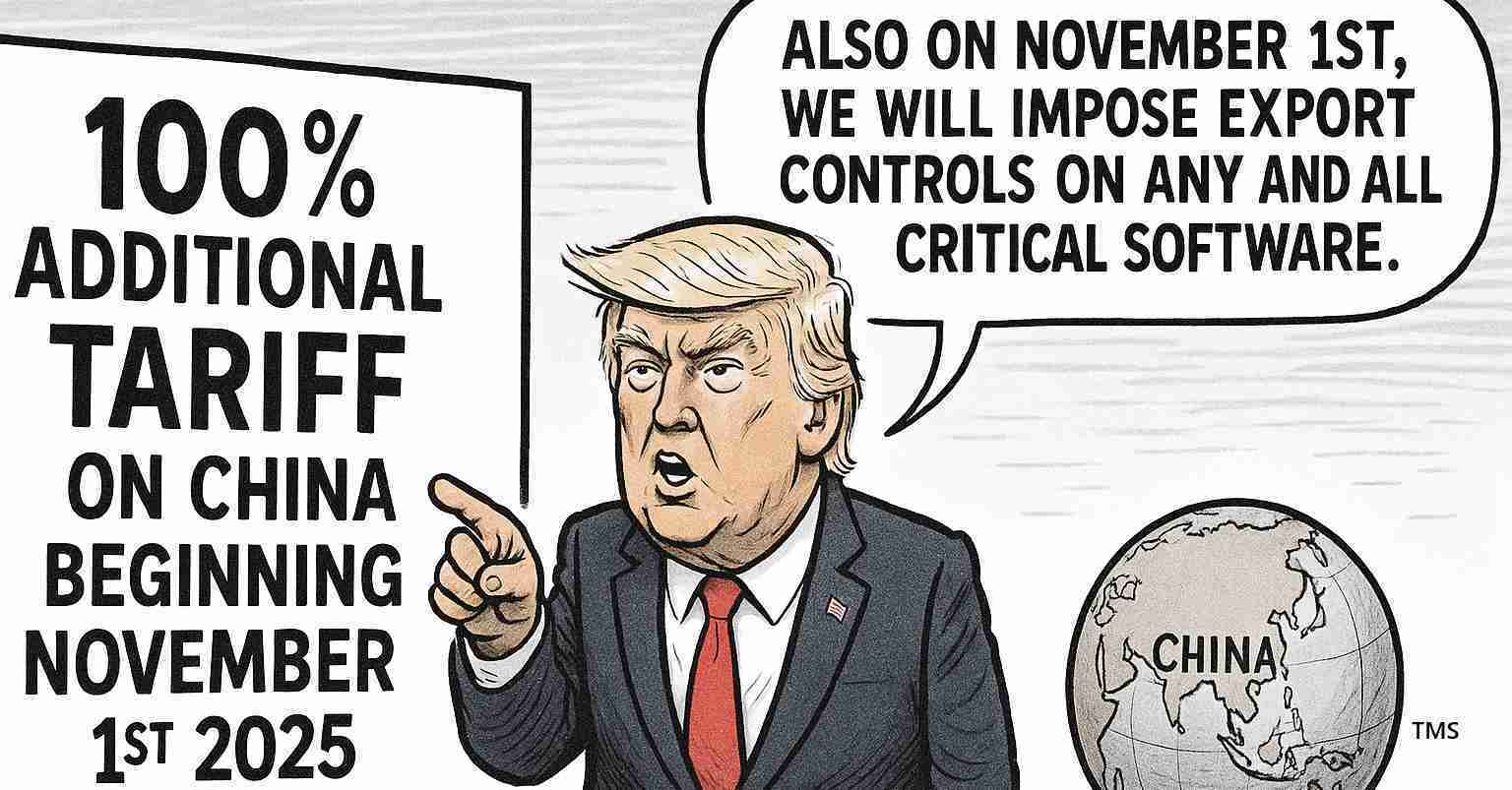
Donald Trump announced an additional 100% tariff on all imports from China effective Nov. 1, 2025, responding to Beijing’s expanded export controls on rare earth minerals—moves that could sharply raise costs and disrupt global technology and defense supply chains.
- Major escalation: An extra 100% tariff would be added on top of existing U.S. duties, potentially pushing combined rates to about 130%; CBS News, The Economic Times
- Export controls: The administration will also impose limits on “any and all critical software” bound for China, effective the same date; CBS News
- Rare earths targeted: Beijing expanded export controls to cover 12 of 17 rare earth elements, including holmium, erbium, thulium, europium and ytterbium; The Economic Times
- Industry risk: Analysts warn possible disruptions to semiconductors, EVs, jet engines and defense systems due to China’s dominance in rare-earth processing; CBS News, The Economic Times
Tariff details and timing
President Trump announced the 100% tariff via social media, calling China’s export controls “extraordinarily aggressive” and a “moral disgrace.” He said the levy would take effect on or after Nov. 1, 2025, and could be implemented sooner if Beijing takes further actions. CBS News
How it stacks: Reporting indicates the 100% surcharge is intended to be applied in addition to existing tariffs on many Chinese goods. Since some covered items already face duties near 30%, combined effective rates could reach roughly 130% for certain imports, sharply increasing landed costs for many products. CBS News, The Economic Times
China’s rare earth export controls
Beijing’s new rules reportedly cover 12 of 17 rare earth elements and require government approval for exports containing trace amounts of those materials — even when embedded in products manufactured abroad by non-Chinese firms. Chinese officials frame the limits as measures to protect national security and to prevent military uses. The Economic Times, CBS News
China controls roughly 95% of global rare earth magnet production and dominates many processing steps — a strategic leverage point that has long concerned U.S. industry and defense planners. Analysts caution that tighter Chinese controls can slow production across semiconductors, EV batteries and aerospace components. CBS News
U.S. export controls on software and other measures
Alongside tariffs, the administration announced export limits on “critical software” destined for China. Officials have not published a full list of covered software products, leaving the scope unclear while the controls are set to begin the same date as tariffs. CBS News
Administration officials signaled independent action rather than immediate coordination with allies, and the President warned he might cancel a planned summit with Xi Jinping if tensions escalate. The Economic Times, The Journal
Reactions and geopolitical stakes
Experts and industry groups warn this could mark a more damaging phase of a US-China trade war. Observers say escalating tariffs and export controls create a “tit-for-tat” dynamic that raises costs and uncertainty for manufacturers, suppliers and consumers. The Economic Times, CBS News
China defends its export rules as security measures. Though an English translation of the rules exists, penalties are not explicit; strict administrative procedures and approval uncertainty can effectively slow or block shipments without detailed punitive language. CBS News
Supply-chain and industry impacts
Industries dependent on rare earths — including chipmakers, EV producers, defense contractors and high-tech manufacturers — face immediate risk. If U.S. buyers cannot procure rare-earth-containing components, production bottlenecks could emerge. Conversely, a 100% tariff would make many parts and finished goods prohibitively expensive or push firms to seek non-Chinese sources. CBS News, CBS News
Some companies may pass higher costs to consumers; others will accelerate diversification to suppliers in Australia, India, Vietnam or Mexico. However, retooling global supply chains requires time, capital and manufacturing footprint changes — constraints that leave many U.S. firms dependent on Chinese-made components for the near term. CBS News
Implications for Las Vegas, Nevada
Economic impact: Las Vegas’ tourism and hospitality economy relies on imported electronics, gaming equipment, appliances and supplies. A sudden jump in import costs could raise operating expenses for casinos, hotels and retailers — potentially fueling higher room rates, food prices or fees and dampening discretionary spending. CBS News, The Economic Times
Technology and gaming supply chains: Slot machines, display screens, payment systems and replacement parts may face delays or higher costs. Vendors serving hospitality — from kitchen equipment to smart-room systems — could see price increases that affect maintenance and upgrade plans. CBS News
Labor and employment: Higher operational costs may force some hotels and small businesses to curb hiring, limit raises or reduce hours — impacting workers who rely on steady schedules and tips. CBS News
Defense, research & EVs: Southern Nevada’s defense contractors, military facilities and EV research projects could see longer lead times and higher costs for parts and components, potentially slowing projects tied to battery manufacturing and charging infrastructure. CBS News, The Economic Times
What local businesses can do
- Inventory and contracts: Review contracts and inventory critical supplies now; check origin-of-components rules and lead times. CBS News
- Supplier communication: Ask suppliers for timelines and alternatives, and document component origins to anticipate duty exposure.
- Diversify strategically: Explore suppliers in other countries or consider stockpiling key parts where feasible; engage local chambers and state commerce for guidance. CBS News
Legal and trade questions
Trade lawyers note implementation challenges: rapid changes to tariff lines and enforcement mechanisms, potential exemptions, and practical problems determining when goods carry rare-earth content given complex cross-border manufacturing. Companies and customs officials may face confusion about which parts and assemblies trigger added duties. CBS News
Sources and coverage
This report draws on multiple news outlets and primary reporting: CBS News; CBS News (rare earths); The Economic Times; The Journal; YouTube clip; and Axios.
“This is an escalation that could reshape supply chains and national security calculations,” said trade and industry analysts commenting on the tariffs and Beijing’s export controls.
For local businesses in Las Vegas: begin contingency planning now — review contracts, check inventory, and reach out to trade groups and state economic offices for guidance.