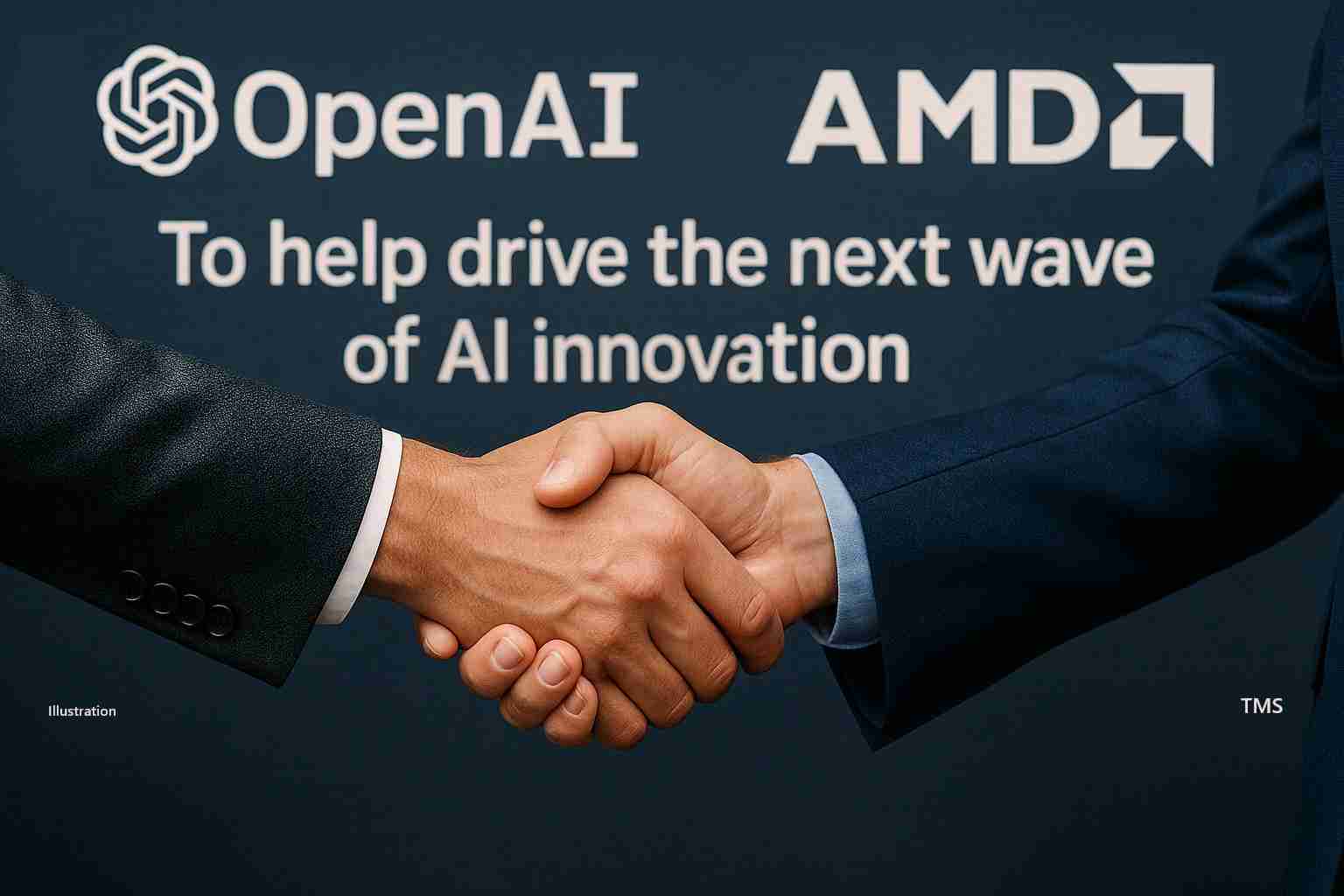
AMD, OpenAI unveil massive GPU pact as race to power AI intensifies
AMD and OpenAI unveiled a landmark agreement for up to six gigawatts of AMD Instinct GPUs, beginning with the MI450 series in H2 2026, and warrants for 160 million AMD shares—tied to deployment and stock milestones.
- Commitment: OpenAI may purchase up to six gigawatts of AMD Instinct GPUs, starting with the MI450 family.
- Financials: Deal could be worth roughly $90 billion across multiple hardware generations and includes warrants for 160 million AMD shares at $0.01 each.
- Strategic angle: The pact ties supply agreements to equity upside, aligning OpenAI’s deployments with AMD’s long-term value creation.
- Market reaction: AMD shares jumped more than 35% on the news.
What the deal says
The agreement links OpenAI’s planned data-center growth directly to AMD’s roadmap. OpenAI is set to buy large-scale AMD Instinct GPUs—initially the MI450 (CDNA4) family—and later MI500-class devices as AMD advances its platforms. The headline figure—six gigawatts of GPU capacity—is enormous in raw power and implies a multi-year, multi-generation procurement strategy.
A notable financial element grants OpenAI warrants to buy up to 160 million AMD shares at $0.01 per share. Those warrants vest in stages tied both to OpenAI’s GPU deployments and to AMD share-price milestones—reports suggest milestones reach as high as $600 per share. The staged vesting is explicitly designed to align incentives so that scaled deployments help increase AMD’s value, which in turn benefits OpenAI.
For further reporting and analysis, see More Than Moore and The Next Platform.
Technical and product details
The MI450 family is framed for rack-scale deployment rather than isolated chip performance: AMD emphasizes system-level integration of compute, interconnect, and memory bandwidth. The goal is to accelerate both large-model training and inference at hyperscale.
AMD’s Helios reference platform bundles MI450 GPUs with Zen 6 CPUs, high-bandwidth memory, and advanced interconnect in a pre-engineered data-center block. Helios focuses on systems integration, cooling design, and software tuning to make deployment more predictable for hyperscalers—essentially selling a deployable block rather than individual cards.
Software will be central: the pact includes ramping AMD’s ROCm open software stack across thousands of nodes to ensure performance and ease of use at scale. That integration is presented as critical to deliver “predictable, efficient scaling” and substantial revenue potential for AMD over time (More Than Moore).
Market reaction and financial engineering
Investors reacted rapidly: AMD stock surged more than 35% after the announcement, reflecting market confidence that the deal could accelerate AMD’s AI-hardware growth. Financial observers note the warrant structure is unusual and could lead to large equity stakes for OpenAI if multiple vesting targets and aggressive share-price milestones are met.
Analysis places staged values of the warrants in the billions—estimates vary, with some scenarios suggesting roughly $9 billion in 2025 value and potentially $11.2 billion in 2027 under certain models. At the most aggressive theoretical milestones, the implied upside is even larger, underscoring the novel mix of hardware supply and equity incentives (The Next Platform).
Statements from leaders
AMD CEO Lisa Su called the agreement a major step toward the next wave of AI innovation. OpenAI President Greg Brockman said the partnership creates a shared path to scale training and inference for increasingly large AI models. Both emphasized strategic alignment between AMD’s hardware roadmap and OpenAI’s infrastructure needs (More Than Moore; The Next Platform).
“This partnership creates a shared path to scale training and inference,” said OpenAI leadership, framing the pact as a long-term infrastructure alignment.
Why this matters in the AI race
The agreement changes the competitive map. NVIDIA has long dominated data-center GPUs; AMD’s MI450 and the Helios platform represent a system-level alternative designed to compete on rack-scale performance and predictable deployment. Locking in a long-term buyer with equity upside gives AMD a committed partner to scale its stack, while OpenAI secures predictable supply and tighter hardware-software integration.
Industry watchers say this could become a template: large purchase commitments combined with equity alignment to lower supply risk and accelerate deployment for hyperscalers as compute demand grows (More Than Moore).
Questions and risks
- Warrant complexity: Aggressive share-price milestones could create unpredictable exposures and governance questions for both firms.
- Operational hurdles: Deploying six gigawatts of GPUs requires massive investments in power, cooling, rack design, and networking.
- Competitive response: Incumbents and new entrants may react with pricing, product, or partnership moves that alter the expected economics.
Implications for Las Vegas, Nevada
Economic impact: Las Vegas and Nevada more broadly could attract data-center projects if the region offers favorable power costs, permitting, and available high-density space. Large GPU farms bring construction jobs, facility operations roles, and local contracting opportunities for electrical work, logistics, and maintenance.
Political consequences: Local and state leaders would likely engage on permitting, tax incentives, and grid upgrades. The scale of power and infrastructure needs could push public discussions about energy policy, renewable sourcing, and long-term utility commitments.
Social effects: Benefits include jobs and investment; concerns may center on water use for cooling, construction traffic, and land-use changes. Community groups will want transparency on environmental impact and workforce inclusion.
Cultural relevance: Hosting major AI infrastructure could be another chapter in Las Vegas’s economic reinvention—opening doors for local universities, bootcamps, and meetups to form industry partnerships.
Practical applications for residents:
- Job and training programs for technicians, electricians, and facilities managers.
- Potential infrastructure projects that could affect local power rates and municipal planning.
- Local contracting opportunities in construction, logistics, and operations.
- Education partnerships offering internships and certifications tied to deployments.
Sources and further reading
Preserve original reporting and analysis: More Than Moore and The Next Platform.