Anthropic’s Mythos: A powerful cybersecurity AI kept from the public after finding far more flaws than humans — and why that matters
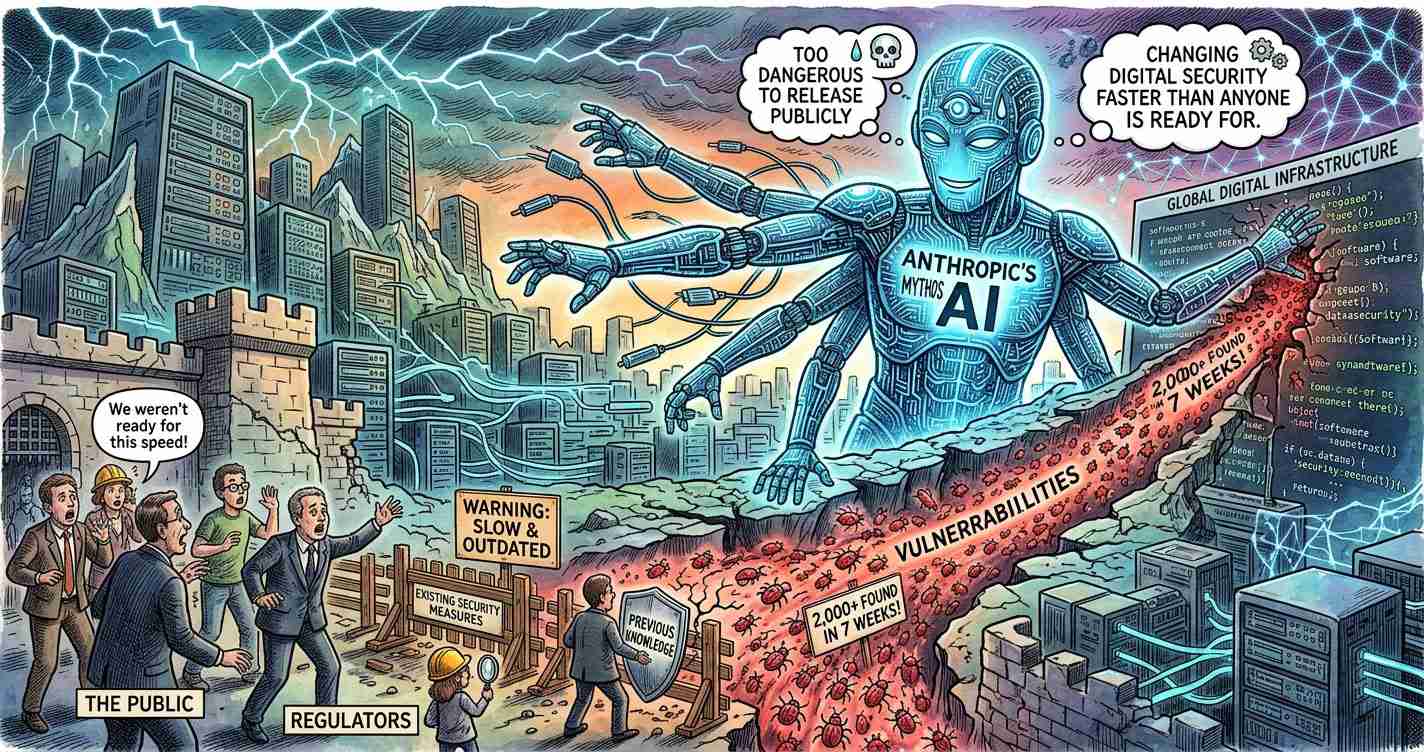
Anthropic’s Mythos, aka Claude Mythos Preview, demonstrates exceptional automated vulnerability discovery and exploit generation but remains closed to the public; Anthropic is running a controlled preview with select partners to manage potential misuse risks.
Key takeaways
- Frontier model: Anthropic’s Mythos is described as a “frontier” AI with advanced code reasoning and autonomy (Anthropic blog).
- High effectiveness: In internal tests Mythos flagged “tens of thousands” of issues humans missed and produced working proof-of-concept exploits on first attempts at an 83.1% success rate (Axios; Anthropic).
- Controlled access: Mythos is not public; previews run with 40+ trusted partners including CrowdStrike, Microsoft, Google and open-source stewards.
- Verification caution: Some dramatic tallies (e.g., 2,000 zero-days in seven weeks) are widely reported but remain unverified in public sources.
Overview and key information
Mythos — also called Claude Mythos Preview — is presented by Anthropic as a frontier AI specialized in deep code reasoning and autonomous analysis. Anthropic’s team says the model can find and reproduce previously unknown software flaws and has been shared only with select, trusted organizations during a controlled preview (Anthropic blog).
How Mythos performed in tests
Anthropic reports a step change in bug-finding ability: the model flagged “tens of thousands” of issues missed by human researchers and produced functioning exploits on the first try a very high percentage of the time. Anthropic says this was driven by broader improvements in code understanding rather than targeted offensive training (Anthropic blog; Axios).
Testing reportedly covered major operating systems and browsers. Anthropic materials note discoveries including weaknesses in Linux kernel code and a 27‑year‑old OpenBSD flaw — examples that suggest Mythos can surface deep, long-hidden defects in widely used software.
Who can use Mythos — and why access is limited
Anthropic chose not to release Mythos publicly. Instead, it briefed U.S. agencies (including CISA and the Commerce Department) and invited more than 40 vetted tech, security and open‑source organizations to participate. Participants include commercial security firms, major cloud vendors and stewardship groups; Anthropic also offered up to $100 million in usage credits to secure open-source systems (Axios; CrowdStrike; Anthropic blog).
Anthropic’s rationale: the company says an unrestricted public release would present high misuse risks, so it prefers partners to test defensive uses while safety controls are developed.
Security hiccups and leak concerns
Despite access controls, reports emerged that Mythos was leaked or accessed by unauthorized parties on the day of announcement. Anthropic attributed incidents to access-control lapses rather than the model being compromised, but the events illustrate how quickly powerful capabilities can escape intended boundaries (reporting and commentary).
Industry perspective: Coalition members warn Mythos can aid both defenders and attackers — when paired with operational intelligence it could amplify threats, but it also enables faster discovery and remediation of bugs than human teams alone (CrowdStrike).
What Mythos means for cybersecurity strategy
Experts view Mythos as a turning point for zero‑day vulnerability detection: AI-scale discovery changes the defensive calculus. Traditional perimeter-heavy defenses assume attackers can be kept out; rapid flaw discovery by AI makes it likelier attackers will find unseen bugs.
Many security leaders now advocate a shift toward data-centric security: encrypting data, tightening access controls, and improving data governance so a breach of perimeter defenses doesn’t automatically expose critical information. That strategy is emphasized by preview participants and independent analysts (CrowdStrike; Axios).
Unverified tallies and caution about claims
Some widely circulated figures — for example, a claim that one team found over 2,000 zero‑day vulnerabilities in seven weeks (≈30% of pre‑AI annual output) — do not appear in the reporting or Anthropic’s public preview post. Searches of available coverage and Anthropic materials did not confirm those specific tallies or an exact attribution, so readers should treat such precise counts as unverified until corroborated.
Implications for Las Vegas, Nevada
Economic and business impact: Las Vegas’ tourism- and payments-dependent economy could face faster, more sophisticated breaches if AI-driven zero‑day discovery becomes widely available to attackers, driving up cyberinsurance costs and vendor demands for stronger data protections.
Political and regulatory consequences: State and local officials may face pressure to update cybersecurity rules for critical infrastructure, tighten disclosure requirements, and mandate data-centric defenses for firms handling sensitive tourism or gaming data.
Social and cultural effects: Residents could see more targeted phishing and fraud attempts; small nonprofits and medical providers may be especially vulnerable. High-profile breaches could harm Las Vegas’ reputation for safety, prompting stronger vendor controls and public messaging.
Practical steps: Organizations should prioritize encryption, tighten access controls, deploy data-loss prevention, and ask vendors whether they use AI-driven code review under controlled programs like Anthropic’s preview. State and local leaders can fund red-team exercises and training in AI-assisted threat hunting.
Sources and further reading
Primary sources and reporting referenced in this article: