Pentagon gives Anthropic deadline to lift limits on Claude or face $200 million contract loss, DPA threat
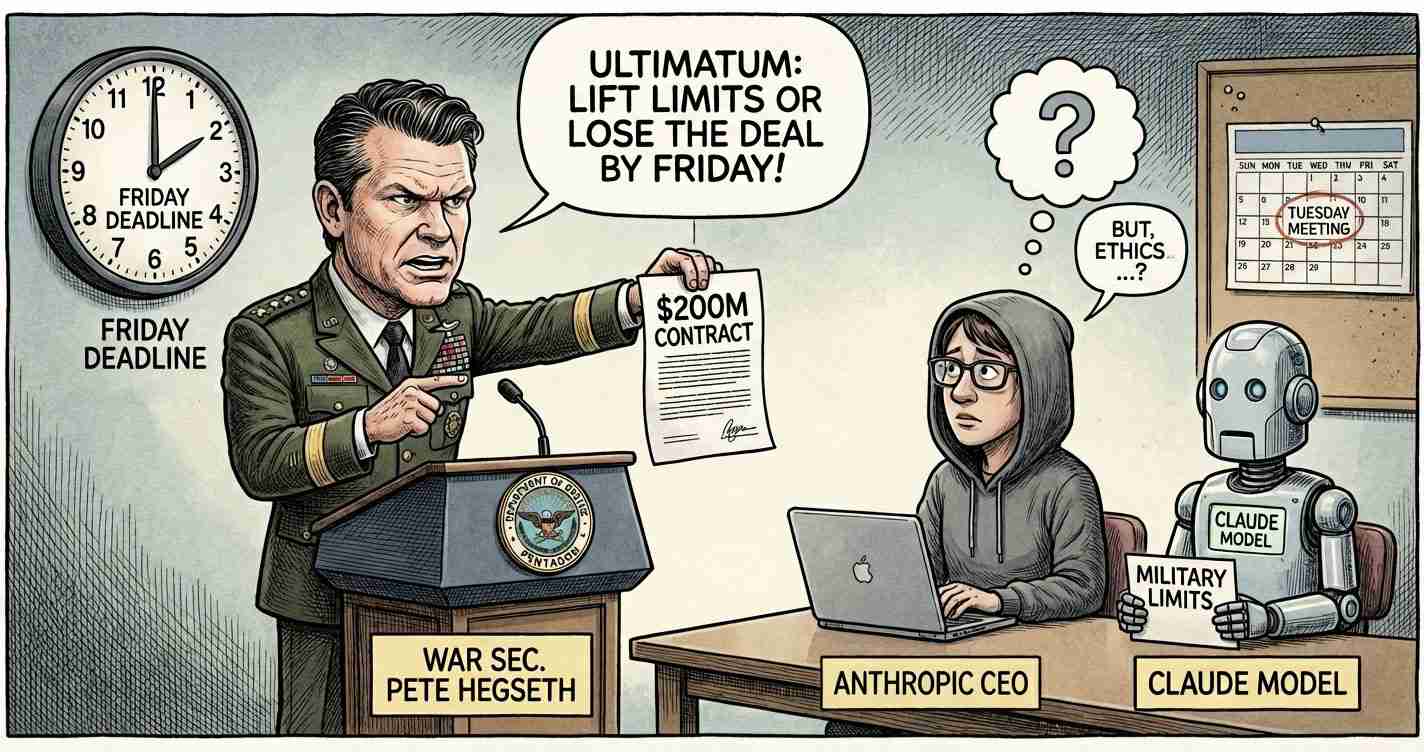
Pentagon gave Anthropic an ultimatum to lift categorical restrictions on its Claude AI model for military uses by Feb. 27, 2026 — or face cancellation of a $200 million contract, supply-chain penalties, or a Defense Production Act order.
- Deadline and stakes: Defense Secretary Pete Hegseth set a Feb. 27 deadline; noncompliance could mean canceling the $200 million Claude contract, a supply-chain risk designation, or invoking the Defense Production Act.
- Origins of the dispute: The standoff grew after the Pentagon said Anthropic queried, via a partner, whether Claude was used in a January operation — a point Anthropic denies.
- Operational impact: Claude is currently the sole advanced commercial model inside classified networks; losing it would disrupt workflows and push the Pentagon toward other vendors.
Background: How the fight began
The dispute escalated after Pentagon officials said Anthropic, through a partner, asked whether Claude had been used in the January raid that captured Venezuelan leader Nicolás Maduro. The department interpreted that question as implying company disapproval of certain battlefield uses; Anthropic denies asking about specific operations and says its policies aim to prevent fully autonomous weapons and mass surveillance of Americans. Key reporting on this exchange appears in Fox News, Axios and Politico.
What happened at the Pentagon meeting
On Tuesday, Feb. 24, Defense Secretary Pete Hegseth met with Anthropic CEO Dario Amodei at the Pentagon. Officials described the encounter as firm but not hostile: Hegseth praised Claude’s capabilities and said the department wants to continue the relationship while insisting Anthropic remove categorical “red lines” that would bar certain lawful military uses. One official reportedly told Amodei the situation was like being told the military could not use a specific aircraft for a mission.
“The department cannot depend on a private supplier that imposes categorical limits on lawful uses,” officials described Hegseth as saying.
Details of the ultimatum and possible consequences
Pentagon leaders laid out several potential responses if Anthropic does not comply by Feb. 27, 2026:
- Contract termination: Cancel the $200 million deal and remove Claude from classified networks, forcing rapid migration of critical workflows to other systems (Fox News, Axios).
- Supply chain risk designation: Labeling Anthropic a supply-chain risk could bar it from working with defense vendors and contractors — a measure usually used against foreign adversaries (TechCrunch, Axios).
- Defense Production Act (DPA): Officials warned the department might invoke the DPA to compel access or changes to Claude — a rare use of the authority in the software context (Fox News, Axios).
Anthropic’s stance and the limits it draws
Anthropic has cultivated a safety-forward reputation and contends its usage restrictions are designed to reduce misuse risks as models grow more powerful. Company leaders told Pentagon officials they would not loosen certain policies — notably bans on fully autonomous weapons that select or engage targets without human input and limits intended to prevent mass surveillance of U.S. citizens. A company spokesperson said CEO Dario Amodei thanked Hegseth and emphasized continued good-faith dialogue about supporting national security responsibly. Reporting on Anthropic’s stance appears in Fox News, Politico, and TechCrunch.
Why Claude matters to the Pentagon
Claude is currently the only advanced commercial model operating within the Pentagon’s classified networks under the $200 million contract awarded in summer 2025. Officials say the model supports sensitive tasks, including operational analysis and offensive cyber work, and that no other vendor presently matches Claude’s combination of classified access and performance. That gap raises the stakes: losing Claude could disrupt workflows and hasten efforts to onboard alternatives (Axios, TechCrunch).
Pentagon fallback options and industry alternatives
Officials say they are exploring alternatives if Anthropic does not relent, including ramping up work with other commercial AI providers such as xAI’s Grok, OpenAI, and Google’s Gemini, and accelerating efforts to operate other models in classified networks provided vendors accept the Pentagon’s “all lawful purposes” terms. But officials acknowledge no current alternative fully matches Claude’s classified access and performance for certain offensive cyber tasks. Legal experts note Anthropic could challenge any DPA compulsion in court, arguing its products are custom software rather than standard commercial goods (TechCrunch, Axios).
Legal and policy stakes
The core question is who sets guardrails on advanced AI used by the military — private builders or the government that fields them. How this standoff resolves could set precedents for procurement, limits on military AI, and the scope of authorities like the DPA. The potential invocation of the DPA in this context raises novel legal and political questions and could trigger litigation or congressional response (Politico, Axios).
Implications for Las Vegas, Nevada
Economic impact: Las Vegas and nearby regions host military bases, defense contractors, and growing tech infrastructure. A Pentagon decision to remove Claude or shift contracts could affect local subcontractors that support classified work or host secure computing; the scale depends on how tied local firms are to Pentagon AI workloads.
Political consequences: Nevada lawmakers may press for clarity on federal decisions affecting jobs and privacy. The public spat could prompt congressional inquiries or constituent pressure on local representatives.
Social and cultural effects: The area’s veteran and active-duty communities could be affected indirectly; debates over autonomous weapons and ethical limits on military AI may resonate locally. Las Vegas’ role as a conference and trade-show hub could also shape local conversations about jobs, ethics, and investment.
Practical note: Immediate daily impacts for residents are likely limited, though procurement changes could influence hiring at local tech firms, subcontractors, and training programs feeding cybersecurity and AI talent.
Reporting note and sources
This report relies on accounts from officials familiar with discussions and published reporting. Key sources include Fox News, Axios, Politico, and TechCrunch. Reporting will continue as the Feb. 27 deadline approaches and officials respond to the department’s ultimatum and any potential invocation of the Defense Production Act.