Violent Clashes Break Out at Turin Askatasuna Protest; 108 Security Personnel Injured as PM Meloni Condemns Violence
Violent clashes erupted in Turin on Jan. 31, 2026, during a demonstration supporting the Askatasuna social center, injuring 108 security personnel and prompting condemnation from Prime Minister Giorgia Meloni as authorities consider new security measures.
Key takeaways
- 108 security personnel reported injured, including police, Guardia di Finanza and carabinieri.
- Crowd estimates ranged between about 15,000 and as many as 50,000.
- Prime Minister Meloni visited injured officers and vowed a firm government response.
The protest and scale
Organizers and media reports said tens of thousands marched in Turin to support Askatasuna after authorities evicted the decades-old social center long occupied by far-left activists. Estimates of the march size ranged from about 15,000 to as many as 50,000 participants, drawing activists from across Italy and parts of Europe.
The march began largely peacefully, with demonstrators calling for protection of social centers and criticizing the eviction. Attendees included grassroots unions, regional activists and public figures who had supported Askatasuna for years.
Escalation and violence
Authorities say the situation turned violent after masked groups split from the main march as evening fell. Investigators described coordinated black bloc-style formations that armed themselves with improvised explosives, fireworks and blunt instruments.
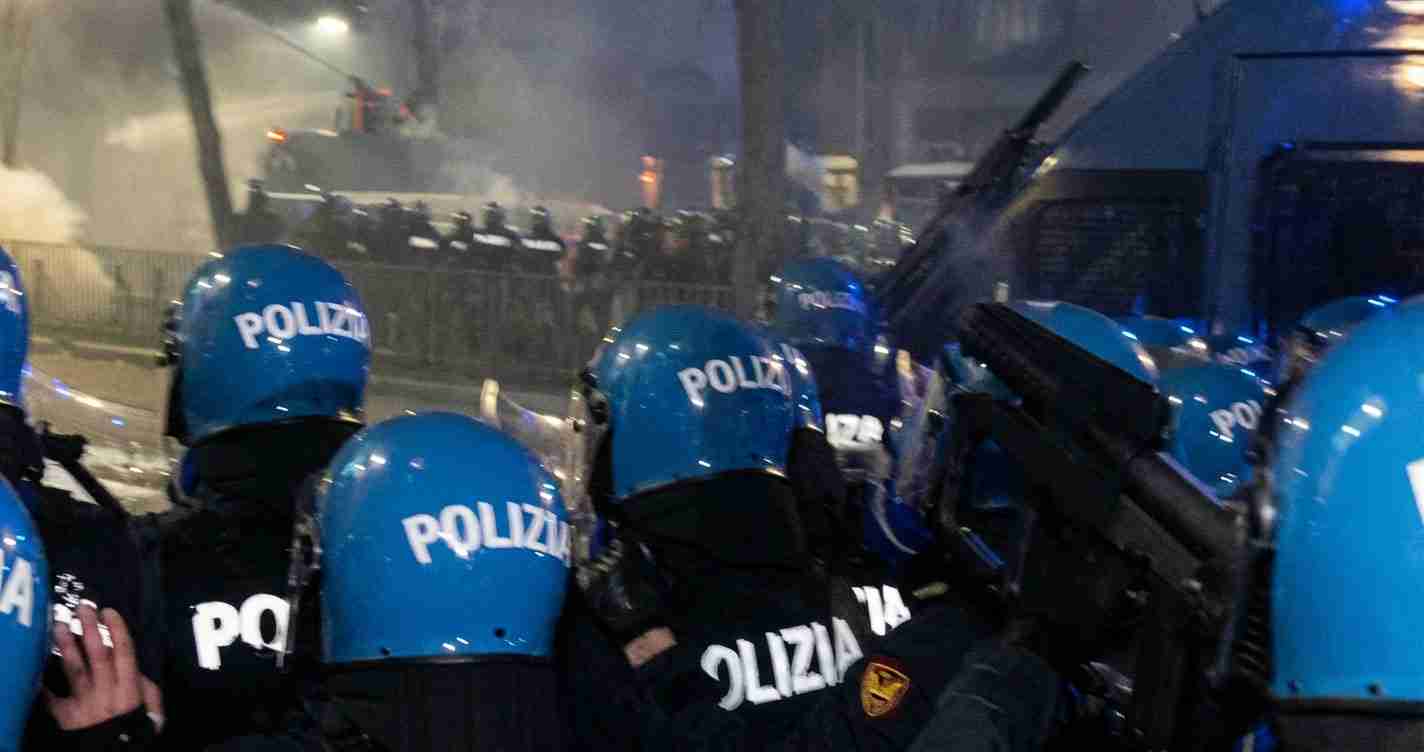
Video and photo coverage showed demonstrators dressed in black confronting police lines, with footage appearing to capture objects hurled at officers, police pushed backward, and red smoke surrounding riot police. Protesters reportedly used bottles, stones, homemade incendiary devices, smoke bombs and more, and there were scenes of trash bins and a police armored vehicle set on fire.
Police replied with tear gas and water cannon and moved to regain control after roughly two hours of intense fighting. Investigators reported finding nail-filled paper bombs and other improvised devices among items used to attack security forces. Much of this reporting is summarized by onlookers and regional outlets.
Casualties and damage
Italian authorities said 108 security personnel were injured. Officials provided a breakdown: 96 police officers, seven Guardia di Finanza personnel and five carabinieri, as reported by Anadolu Agency. Emergency services also treated some demonstrators; media accounts put the total number treated at about 25–30.
One severe assault described by authorities and witnesses involved an officer surrounded and struck repeatedly with a hammer, suffering head and shoulder injuries and a dented helmet — an incident officials labeled an attempted murder; the officer is expected to recover.
Property damage included smashed windows at banks and shops, burning dumpsters and damage to public infrastructure; a police armored vehicle was set ablaze during the clashes.
Government response and policy debate
Prime Minister Giorgia Meloni visited injured officers at Le Molinette hospital in Turin and issued a forceful public response. She described the violence as “organized criminal activity” and said the attackers were not protesters but criminals using weapons meant “to kill us.”
Meloni: The attacks were organized criminal activity, not legitimate protest — criminals using weapons meant to kill our representatives.
Interior Minister Matteo Piantedoli called the groups involved “a danger to democracy”, accusing parts of the political left of shielding violent elements. The government scheduled a meeting to assess new security measures and reportedly is considering options including a possible security decree, broader legal protections for officers, and preventive detention for individuals deemed a threat ahead of demonstrations (analysis; reporting).
Experts and context
Experts on extremist movements say the scale and style of violence in Turin fit patterns seen in other European cities where anarchist and far-left networks operate. Dr. Lorenzo Vidino, director of the Program on Extremism at George Washington University, noted that Turin has been a longtime center for hardcore anarchist and communist groups; images from the clashes, while shocking, are not entirely unprecedented in the region (Fox News).
Investigators are reviewing footage and intelligence to identify attackers and determine how militants may have coordinated. Officials say a minority of hardened activists steered the protest toward violence while the larger crowd had come to demonstrate peacefully in support of Askatasuna (report).
Implications for Las Vegas, Nevada
Large violent clashes in major tourist cities can affect global perceptions of safety. Las Vegas, which depends heavily on tourism and large public events, may watch developments in Italy for lessons about protecting crowded public spaces and ensuring visitor confidence.
For urban, moderate audiences in Las Vegas, the Turin clashes underscore the balance city leaders must strike between preserving the right to protest and protecting public order. The Italian debate over preventive detention and expanded police immunity may prompt local civic groups and policymakers to review protest-management plans.
Community leaders, neighborhood associations and nonprofits in Las Vegas might increase dialogue with protest organizers to prevent escalation and consider how to diffuse tensions around occupations or long-standing social spaces.
Practical applications for local authorities and residents
- Event planning: Review crowd-control strategies and consider nonviolent de-escalation training for officers and stewards (reference).
- Public messaging: Timely, transparent communication can limit misinformation and reassure visitors and partners.
- Medical readiness: Hospitals and emergency services should examine surge plans for mass-casualty or large-injury incidents, as seen in Turin (report).
- Community outreach: Expand engagement with demonstration organizers to set safety expectations and routes, reducing the chance fringe elements hijack protests.
Sources and further reading
Reporting compiled from Times Media Service and the sources below: