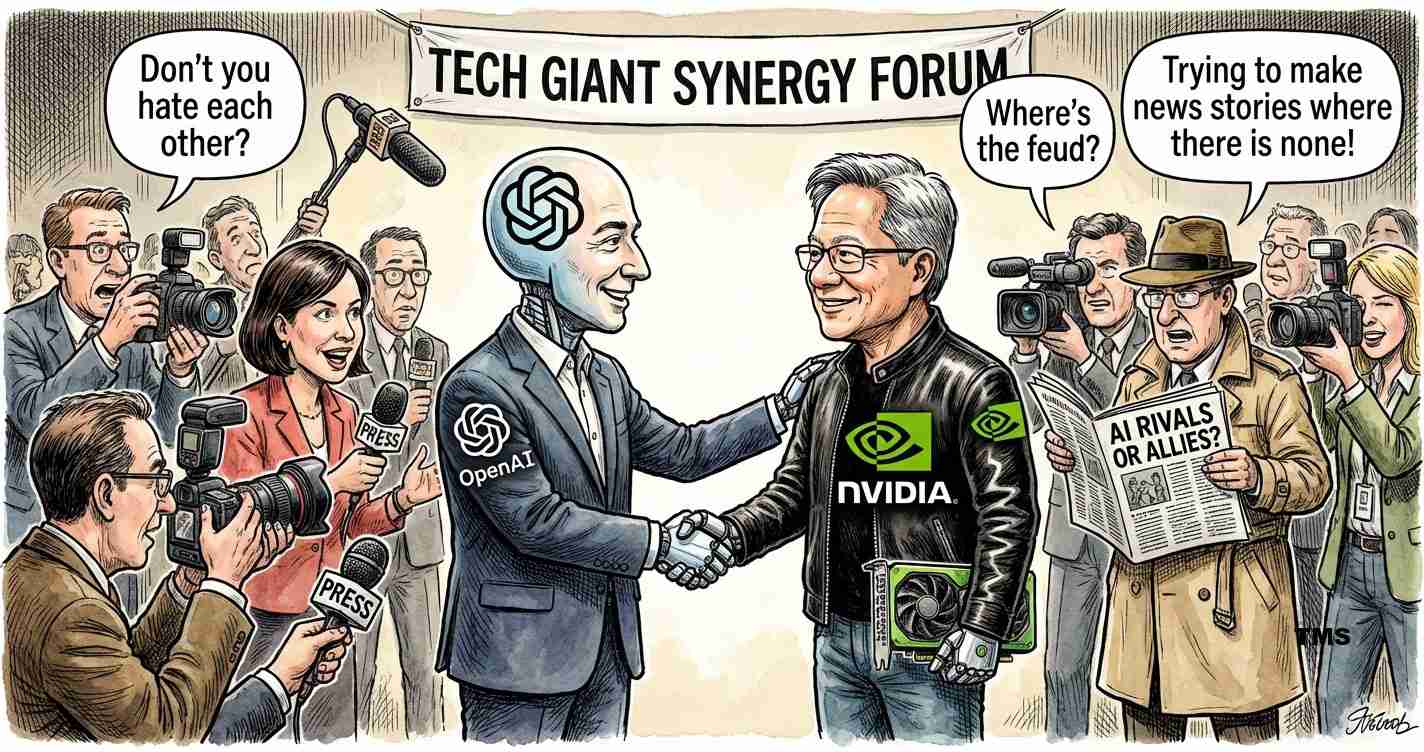
Nvidia’s Jensen Huang Calls Report of Stalled $100B OpenAI Deal “Nonsense,” Says Company Will Make a “Huge” Investment
Nvidia CEO Jensen Huang denied reports that a stalled $100 billion investment in OpenAI were true, calling them “nonsense” in Taipei and saying Nvidia will make a “huge,” possibly its largest, investment in OpenAI’s upcoming funding round.
- Huang reaffirmed participation: Nvidia will “definitely participate” and “invest a great deal of money” in OpenAI’s next funding round — reported by TechCrunch.
- September plan: Nvidia previously announced plans to invest up to $100 billion and build 10 gigawatts of compute capacity for OpenAI — see TechCrunch.
- Deal uncertainty: Reporting summarized a Wall Street Journal piece that the non-binding $100B plan had stalled and talks shifted toward a smaller tens-of-billions equity stake (coverage also summarized by MLQ).
What Huang said in Taipei
Speaking to reporters in Taipei, Jensen Huang pushed back directly on coverage suggesting Nvidia had grown unhappy with OpenAI. He called those stories “nonsense” and said Nvidia planned to make a “huge” — possibly its largest — investment in the upcoming funding round. He declined to name a specific dollar amount.
“We will definitely participate and invest a great deal of money,” Huang told reporters, rejecting narratives that the partnership had fizzled.
Context and recent reporting
The comments followed reporting that internal doubts at Nvidia had slowed talks. A Wall Street Journal article, summarized by other outlets, described the original $100 billion plan as non-binding and noted some inside Nvidia questioned the scale. Subsequent summaries by industry outlets reported that investor discussions had shifted toward a smaller equity investment in the tens of billions (TechCrunch; MLQ).
Background: the $100B plan and why it matters
In September, Nvidia announced a headline-making proposal tied to OpenAI: an offer to invest up to $100 billion and to build up to 10 gigawatts of computing infrastructure so OpenAI could secure advanced Nvidia chips at scale. That package signaled deep strategic alignment: Nvidia would anchor demand for its high-end AI chips, and OpenAI would lock in critical hardware to train and run ever-larger models (TechCrunch).
Analysts say the scale matters for two reasons:
- It would anchor a massive funding round to keep OpenAI competitive with rivals like Google and Anthropic.
- It would signal to other investors that OpenAI has long-term access to chips and infrastructure needed for advanced AI work.
Why some within Nvidia may have hesitated
Reportedly, Nvidia executives and directors weighed several risks: the initial agreement was non-binding, concerns about concentrating massive capital in one private firm, governance and accountability questions at OpenAI, and optics around concentrated influence. Huang has privately criticized aspects of OpenAI’s business discipline and warned about competition from Alphabet/Google and Anthropic even as he called OpenAI “one of the most consequential companies of our time” (TechCrunch).
The reported compromise: a smaller, tens-of-billions equity investment that secures supply ties without the full $100 billion commitment (MLQ).
OpenAI’s position and the broader funding round
OpenAI is reportedly targeting around $100 billion from a mix of investors — including Nvidia, Microsoft, Amazon and SoftBank. An OpenAI spokesperson said the partnership with Nvidia remains active and that Nvidia plays a foundational role in OpenAI’s systems, suggesting alignment persists even as deal size and structure are debated (TechCrunch).
Regulatory and strategic concerns
A near-$100 billion tie between a leading chipmaker and a dominant AI platform would attract regulatory scrutiny: competition concerns, access to critical technology, and market-power concentration. National security and export controls for cutting-edge chips could complicate or slow large deals, and those considerations may have contributed to internal caution at Nvidia.
Implications for Las Vegas, Nevada
Local and regional effects could be substantial if compute infrastructure or data centers tied to the deal land in Nevada:
- Economic impact: Job growth in construction, data-center operations and high-skill tech roles; opportunities for local firms in hospitality, gaming tech and entertainment to adopt advanced AI tools.
- Power & infrastructure: The 10-gigawatt figure underscores grid, transmission and renewable-energy challenges; large-scale deployment could accelerate upgrades but strain utilities in the near term.
- Workforce & education: Demand for AI and cloud-computing programs at UNLV and community colleges; potential public-private reskilling efforts for hospitality workers.
- Local business opportunities: Faster access to AI-powered marketing, customer service and operational tools for casinos, entertainment venues and SMEs.
- Political & regulatory consequences: City and state leaders must balance economic development with community concerns about energy, water for cooling, and land use.
Practically, residents may first see job listings for data-center technicians, new university programs, and incremental AI-driven services — but long-term effects could touch housing demand, transportation and wages.
Questions to watch in the coming weeks
- Will Nvidia specify the size or structure of its “huge” investment? Huang declined to name a figure in Taipei (TechCrunch).
- Will the final commitment be the full $100 billion, a smaller tens-of-billions equity stake, or a multi-part deal combining chips, infrastructure and capital?
- How will regulators respond if a massive capital tie-up between hardware and AI software firms is announced?
- What steps will Nevada and Las Vegas officials take to prepare for potential data-center growth while managing power, water and land-use impacts?
Reporting notes and sources
This article draws on reporting by TechCrunch and related coverage summarizing a Wall Street Journal report and other industry sources. Additional context and summaries appear at MLQ.