
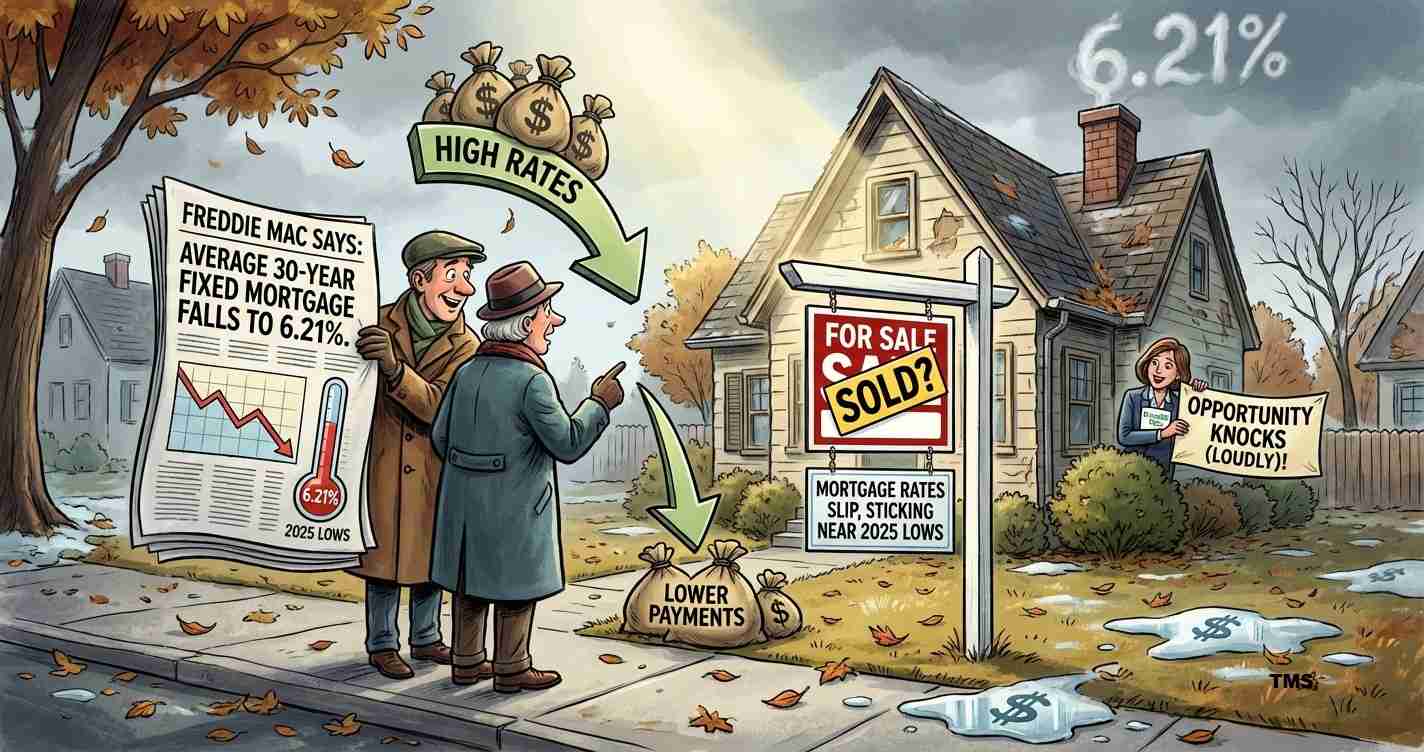
Mortgage rates slip near 2025 lows — 30-year fixed falls to 6.21%, what Las Vegas buyers should watch
Mortgage rates dipped slightly, with the average 30‑year fixed at 6.21% for the week ending Dec. 18, 2025, keeping borrowing costs near 2025 lows and offering a narrow window of improved affordability for buyers and potential refinancers.
Key takeaways
- Freddie Mac put the average 30‑year fixed at 6.21% for the week ending Dec. 18, 2025 — near this year’s lows and roughly 39 basis points below Dec. 2024 (Mortgage News Daily, FRED historical series).
- Daily trackers showed similar averages (around mid‑6%); short‑term moves follow Treasury yields more than the Fed’s policy (The Mortgage Reports, Bankrate).
- For Las Vegas buyers and homeowners, even small declines can affect affordability, refinancing calculus, and local market activity.
Main story
What Freddie Mac reported and why it matters
Freddie Mac’s weekly survey — a widely watched snapshot of conventional mortgage pricing — showed the 30‑year fixed mortgage rate at 6.21% for the week ending Dec. 18, 2025, down slightly from 6.22% the prior reading. That one‑basis‑point change is small, but the reading is notable because it keeps rates close to the lows seen this year. Year‑over‑year the 30‑year rate is nearly 40 basis points lower than Dec. 2024’s average of 6.60% (Mortgage News Daily; FRED historical series).
“A small dip keeps rates near 2025 lows, but 6.21% remains well above the ultra‑low environment of earlier years — affordability is still tight for many buyers.”
Daily surveys and short‑term moves
Daily trackers showed small swings around the Freddie Mac weekly number. Mortgage News Daily recorded 6.22% on Dec. 18 and 6.25% on Dec. 19 (Mortgage News Daily). Bankrate showed 6.25% on Dec. 19, and The Mortgage Reports posted 6.251% on Dec. 20. These tiny daily moves reflect bond market flows and lender hedging/pricing differences — hence different trackers can show slightly different numbers on the same day.
Fed cut vs. mortgage market: the real link
The Federal Reserve cut its benchmark federal funds rate by 25 basis points to a 3.50%–3.75% range roughly a week before Freddie Mac’s reading (coverage: Fox Business). Still, mortgage rates tend to track the 10‑year U.S. Treasury yield — which hovered near 4.12% on Thursday — more closely than the Fed’s short‑term policy rate. In short, the Fed influences the economy and expectations, but the pass‑through to long‑term mortgage pricing is indirect and can lag.
Who benefits from rates near 2025 lows?
- Homebuyers: A modest decline in the 30‑year fixed gives slightly more buying power; a few basis points can change monthly payments and affordability thresholds.
- Refinancers: Homeowners who locked higher rates earlier in the year may find opportunities, but lenders typically require a meaningful spread after fees to justify refinancing (The Mortgage Reports).
- Sellers and the housing market: Lower borrowing costs can support buyer demand, though local supply, prices and wages are also decisive.
Volatility and timing
Recent weeks saw below‑average rate volatility, giving borrowers a calmer shopping window (Bankrate). Still, economic releases or geopolitical events can move Treasury yields quickly, which is why experts advise watching both weekly averages like Freddie Mac’s and daily lender quotes.
Where the numbers come from
Freddie Mac’s weekly survey is built from lender pricing and serves as a common benchmark for the “average” conventional 30‑year fixed rate. Daily trackers such as Mortgage News Daily, The Mortgage Reports, and Bankrate track real‑time lender pricing and can vary by methodology; combining sources gives a fuller picture.
Practical tips for shoppers
- Shop multiple lenders: Different lenders price loans differently even when national averages are steady — use daily trackers to compare (Mortgage News Daily; Bankrate).
- Check total costs: Look beyond the headline rate to APR, points and fees — The Mortgage Reports shows APRs and loan‑by‑loan details.
- Review refinance math: Fees, closing costs and your time horizon determine whether a small rate drop is worth refinancing.
- Consider alternatives: A 15‑year fixed, an ARM, or different down payment can change outcomes depending on goals.
Implications for Las Vegas, Nevada
Las Vegas buyers and homeowners should watch these moves closely. The local market is influenced by tourism, hospitality employment and swings in demand — so even modest rate drops can have local traction.
- Affordability & buyer demand: Slightly lower rates give buyers in Las Vegas marginally more leverage — especially first‑time buyers facing high rents and home prices.
- Refinancing opportunities: Homeowners with older, higher rates should run the numbers; refinancing can free up cash for repairs, debt paydown or investments in short‑term rentals (The Mortgage Reports).
- Local lenders & activity: Lower national volatility can encourage more stable local pricing, nudging listings and sales in an otherwise seasonal slow period (Mortgage News Daily; Bankrate).
- Construction & pricing: Slightly lower mortgage costs can marginally reduce financing costs for builders, but labor, materials and permitting drive new supply.
- Practical advice: If house‑hunting in Las Vegas, start rate searches early and get preapproved — small rate changes can alter the loan size you can afford.
Sources and further reading
- Freddie Mac/weekly 30‑year fixed survey reporting: Mortgage News Daily
- Fox Business coverage on Fed decision and mortgage movement: Fox Business
- Federal Reserve Economic Data (FRED) historical series for 30‑year mortgage rates: FRED historical series
- The Mortgage Reports daily rate roundup: The Mortgage Reports
- Bankrate daily mortgage rate averages and volatility analysis: Bankrate
