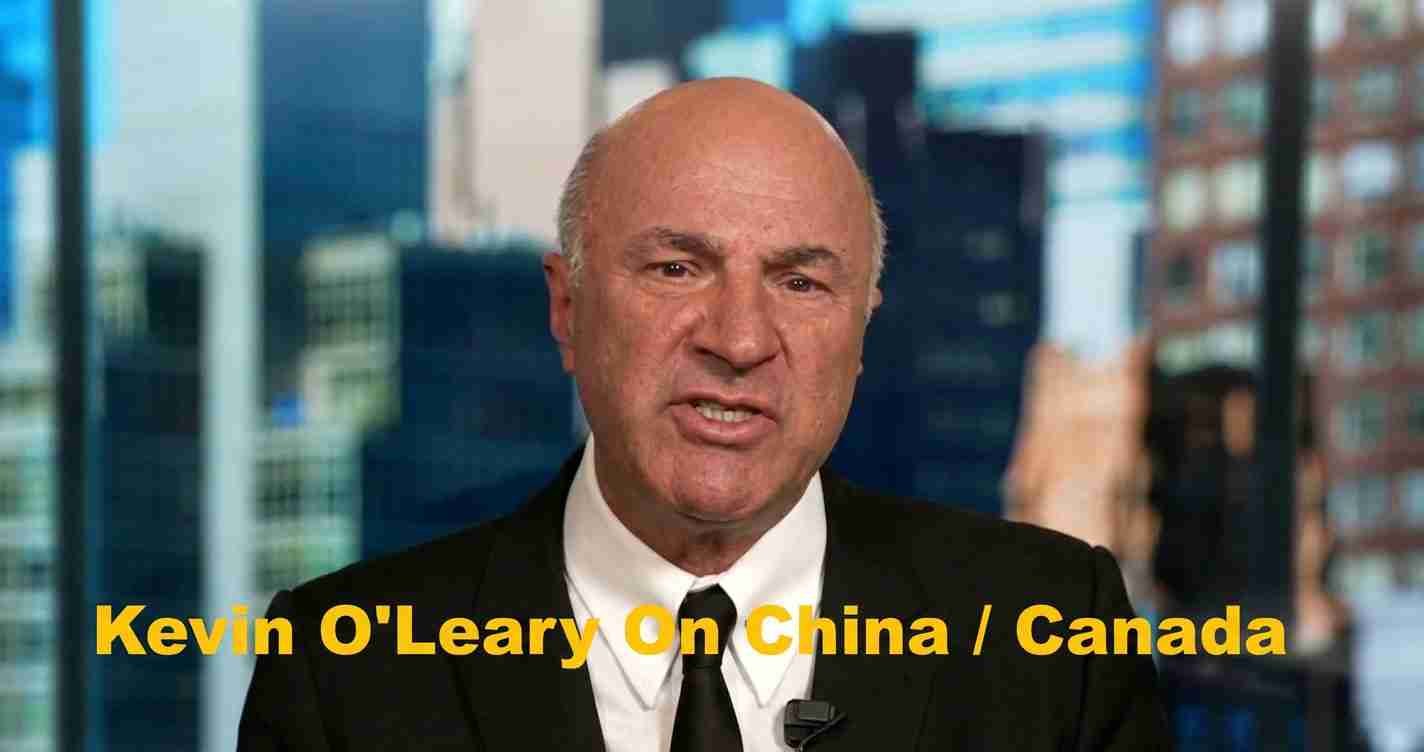
Shark Tank’s Kevin O’Leary warns Canada against closer China ties as Trump threatens 100% tariffs
Amid President Trump’s 100% tariff threat, entrepreneur Kevin O’Leary urged Canada to avoid closer trade ties with China, warning Beijing has harmed partners and insisting Canada prioritize its deep economic relationship with the United States.
Key takeaways
- Kevin O’Leary told Fox Business that Canada should avoid a free trade agreement with China, saying the nation has “screwed” other partners and “is not your friend.”
- O’Leary echoed President Trump in warning that China could use Canada as a gateway into the U.S., matching social-media posts that threatened a 100% tariff on Canadian imports tied to China deals.
- Fox Business misidentified a Canadian official as “Prime Minister Mark Carney”; accurate attribution is essential in diplomatic reporting.
- O’Leary framed China as an economic, military and AI competitor and stressed the deep, interdependent U.S.–Canada trade ties that shape risk.
O’Leary’s warnings on Fox Business
On “The Claman Countdown,” Kevin O’Leary spoke bluntly about Sino-Canadian trade prospects. He repeated that China has “screwed” its partners and argued Beijing is not acting in good faith economically. O’Leary characterized China as “the economic and military and AI enemy to both Canada and the United States.”
He emphasized statistical ties between the U.S. and Canada, noting that Canada is the top export destination for many U.S. states and that a large share of Canadian production flows to the U.S.—a relationship he called “in love that way.” O’Leary suggested a Canadian pivot toward China could create mutual vulnerability.
“Canada is the single largest export market for a large number of U.S. states … much of Canada’s output is sold into the U.S.,” O’Leary said, framing the tie as a strategic economic vulnerability if Canada shifts toward Beijing.
Trump’s social media posts and the 100% tariff threat
President Trump amplified the rhetoric on social media, warning that Canada could become a backdoor for Chinese goods moving into the U.S. and threatening a 100% tariff on Canadian imports tied to any new trade arrangements with China. His posts said a Canadian leader would be “sorely mistaken” to think Canada could be used as a gateway and warned that China would “eat Canada alive.”
Those posts fed into debates about U.S.–Canada trade relations, national security, and the potential economic fallout if tariffs or supply restrictions were enacted.
Canada’s response and source-attribution note
Fox Business reported a Canadian official described a recent China agreement as limited tariff reductions in specific sectors and said Canada had no plans for a sweeping free-trade pact. That same report misidentified the official as “Prime Minister Mark Carney.” Mark Carney is not Canada’s prime minister. This error underlines the need for careful verification of titles and sources in diplomatic reporting.
Defense, diplomacy and the “Golden Dome” idea
Beyond trade, O’Leary invoked national-security arguments for keeping Canada aligned with the U.S. He referenced a proposed missile-defense concept dubbed the “Golden Dome,” arguing Canada’s geography between Greenland and Alaska makes cooperation strategically valuable. O’Leary suggested such defense considerations further incentivize U.S.–Canada alignment despite tariff threats.
The defense point was also featured in related coverage on Fox News and other outlets.
Media coverage and follow-up reporting
O’Leary’s remarks were picked up across outlets, including Fox News and an AOL summary. Independent reporting largely echoed O’Leary’s soundbites and President Trump’s posts; the original Fox Business piece appears to be the primary transcript source used by subsequent summaries.
Readers should cross-check quotes and attributions when political tensions rise and multiple outlets repackage the same remarks.
Implications for Las Vegas, Nevada
A bilateral escalation that affects Canada–U.S. trade could ripple into regional economies, including Las Vegas. Below are the main vectors of potential local impact.
Economic impact
Las Vegas’s economy—rooted in tourism, conventions, hospitality, and growing logistics—relies on national supply chains. Sharp tariff moves or cross-border disruption could increase costs for businesses that source parts or services via Canadian-linked logistics, pushing up operating expenses for local firms in manufacturing, food distribution, and convention supply chains.
Political consequences
Nevada is politically competitive and sensitive to trade stability. Local leaders and business groups may press federal officials for clarity and protections to shield Nevada industries from collateral damage, and the dispute could become a talking point in local races focused on economic competence and supply-chain resilience.
Social effects
Tensions involving the U.S., Canada and China may affect Nevada residents with Canadian ties or businesses that rely on Canadian tourists. Any slowdown in travel or higher costs could dent hospitality revenues and dampen hiring and consumer confidence.
Cultural relevance
As a global entertainment hub, Las Vegas depends on steady international flows for events and investment. Policy debates balancing trade openness and national-security safeguards may influence cultural exchanges, joint events and cross-border collaboration—matters that resonate with Nevada’s diverse electorate.
Practical applications for residents
- Businesses should review supply chains and assess exposure to Canadian inputs; consider contingency sourcing.
- Convention centers, hotels and event organizers should monitor policy moves affecting international attendees and travel costs.
- Local chambers of commerce can engage federal representatives to seek clarity and protections for Nevada interests.
- Residents with investments tied to multinational firms may consult financial advisors about potential volatility from shifts in U.S.–Canada trade policy.
Reporting notes and sources
This article relies primarily on coverage of Kevin O’Leary’s remarks and President Trump’s social-media posts as reported by Fox Business. Additional coverage includes a Fox News video segment and an AOL summary of O’Leary’s predictions.
Readers can review the original Fox Business report here: Fox Business. Related video and follow-up pieces include the Fox News clip and the AOL coverage.
Journalistic clarification
Correction note: Some reporting cited above misidentified the Canadian official who commented on trade matters. Journalists should verify titles and attributions; Mark Carney is not Canada’s prime minister. Accurate identification of officials is essential in coverage of international diplomacy and trade policy.