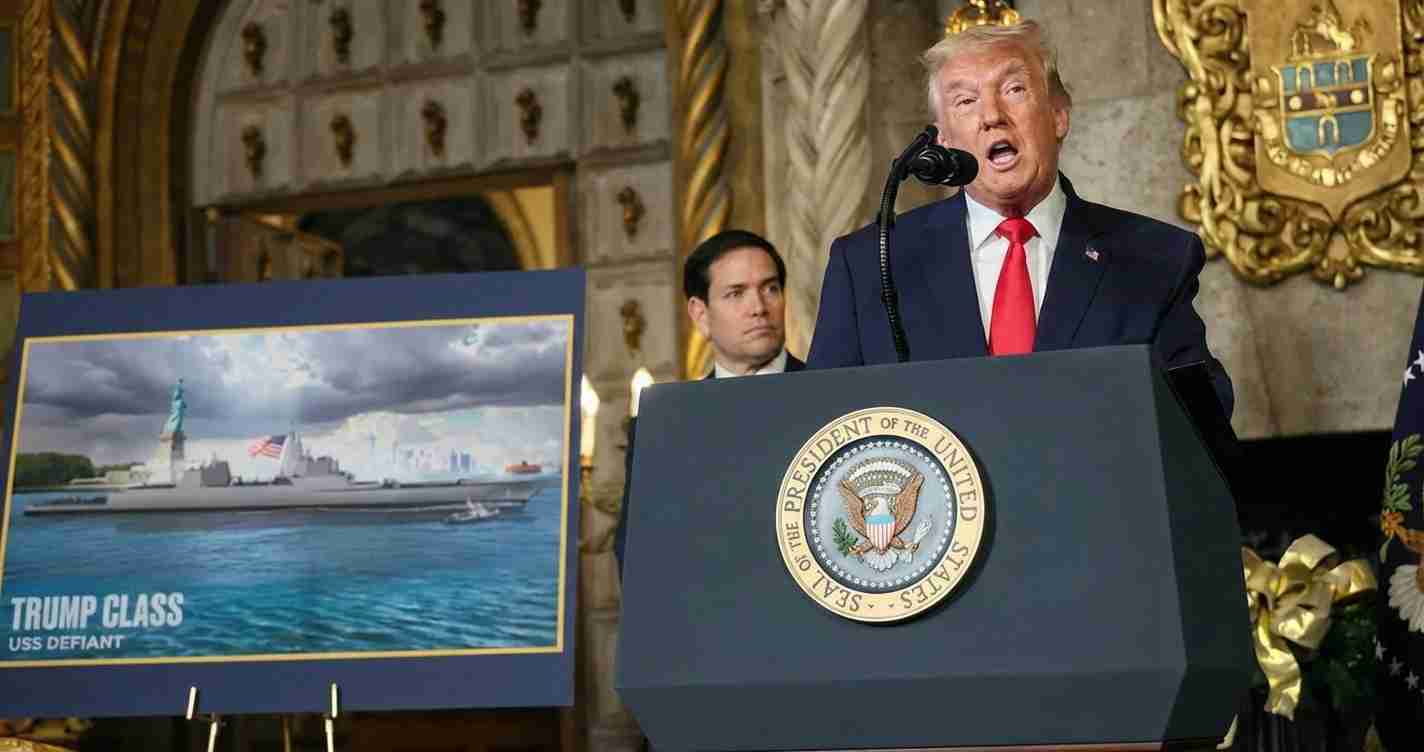
Trump unveils “Golden Fleet” battleships at Mar-a-Lago, vows rapid US Navy expansion
President Donald Trump unveiled the ‘Golden Fleet’ battleship plan at Mar-a-Lago on Dec. 22, 2025, promising rapid construction of a new ‘Trump class’ surface fleet and a broad supply-chain overhaul to restore heavy naval power.
- Announcement: Trump announced the plan Dec. 22, 2025, at Mar-a-Lago flanked by Secretary of War Pete Hegseth and Navy Secretary John Phelan — Video and event coverage.
- Scale & timeline: Immediate procurement of two ships, expand to 10, and ultimately 20–25 vessels; the first two targeted for delivery in about 2.5 years (first operational vessels aimed by 2028).
- Capabilities: Described as a large new surface warship class — dubbed the “Trump class” — discussed as potentially nuclear-armed, raising arms-control and operational questions (NavalNews).
- Missing details: Public materials lacked cost estimates, detailed specs, shipyard plans and a clear congressional approval path (CBS News reporting).
What Trump announced at Mar-a-Lago
Summary: At his Palm Beach club on Dec. 22, 2025, Trump presented the Golden Fleet as a remedy for what he characterized as long-standing shortages and slow U.S. shipbuilding production. He said the ships would be “more powerful than anything we’ve built,” and pledged a fast ramp-up of production and a focus on domestic construction and supply-chain resilience. The event featured senior aides and a public appeal for accelerated defense manufacturing.
“More powerful than anything we’ve built,” — President Donald Trump (remarks at Mar-a-Lago)
The White House framed the plan as both industrial policy and strategic reorientation. Navy Secretary John Phelan described a “smart, quick, affordable build” intended to get the first vessels working by 2028. The administration said procurement would begin immediately on two ships, then expand to 10 and ultimately to 20–25 new battleships over time (CBS News).
What officials did not provide
The announcement was high-level. Public materials and the event did not include:
- Cost estimates or budget breakdowns
- Detailed technical specifications or blueprints
- A clear path for congressional authorization, acquisition funding, or shipyard selection
Independent reporting emphasized the absence of technical and fiscal detail in the initial rollout (CBS News).
Possible capabilities and strategic aims
Observers noted claims that these vessels could be among the largest surface combatants considered for the U.S. fleet and might carry advanced weapons, including reported discussion of nuclear-capable systems. Those reports prompted questions about arms control, command-and-control, and how such ships would fit into modern naval doctrine (NavalNews).
Historical context: the age of the battleship ended decades ago
The U.S. Navy has not commissioned a traditional battleship since the early 1990s. Modern naval strategy moved toward smaller, versatile surface combatants (destroyers, frigates), submarines, and carrier aviation. That background frames practical questions about cost, industrial capacity, and relevance of very large surface combatants in current doctrine (CBS News).
Industrial and budget questions
Scaling up to build 20–25 large surface ships would require:
- Rapid expansion of shipyard capacity and specialized labor
- Secure, long lead-time supply chains for propulsion, weapons, and electronics
- Large, sustained defense budgets and multi-year acquisition planning
Experts have long warned that modern warship construction depends on complex supply chains and skilled labor that cannot be scaled overnight. The announcement did not name shipyards or specify procurement contracts to mitigate historic delays and cost overruns (CBS News).
Legal, diplomatic and arms-control implications
Reports that ships could be nuclear-armed raise distinct legal and diplomatic concerns. U.S. policy and international arms-control frameworks have traditionally separated nuclear strike forces from conventional surface fleets. Introducing nuclear-capable surface combatants would likely provoke scrutiny from Congress, allies, and arms-control advocates. No public documentation with the announcement addressed treaty considerations or command-and-control safeguards for nuclear weapons (NavalNews).
Political reactions and the road ahead
Because the rollout occurred at Mar-a-Lago, the announcement was immediately political as well as strategic. Coverage highlighted that the event was staged at the president’s private club and featured close allies in the national security team. Reporters stressed the lack of procurement-level specifics that normally accompany major defense programs and noted the necessity of congressional authorization and funding to proceed (Video; CBS News).
Sources and reporting
This article is based on the original Mar-a-Lago announcement video and subsequent reporting. Key sources include the event Video, initial coverage and analysis from CBS News, and reporting on potential nuclear-armed surface ships from NavalNews.
Implications for Las Vegas, Nevada
Economic impact
Although Nevada is not a shipbuilding center, an expanded Navy procurement program could ripple through broader defense supply chains. Nevada firms supplying electronics, software, and subcontract manufacturing could compete for work. Increased federal defense spending might bring jobs tied to research, engineering, and logistics rather than hull construction.
Labor and workforce
Rapid shipbuilding requires skilled trades. Nevada community colleges and trade schools could become part of regional training efforts for welders, machinists, and systems technicians if shipyards seek satellite facilities or subcontractors outside coastal hubs.
Political consequences
Nevada’s competitive political environment means local leaders and the congressional delegation are likely to demand clarity on job creation, cost, and funding mechanisms. Senators and representatives from both parties may push for hearings or job guarantees as conditions for supporting appropriations.
Security and community impact
Las Vegas hosts a sizeable military-connected community. A major naval procurement could bring contracts to the region’s defense ecosystem, while also raising local debate about nuclear posture and national priorities. Urban moderates may weigh potential economic gains against concerns about strategic rationale and long-term costs.
Practical considerations for residents
For most residents, the Golden Fleet announcement will not alter daily life immediately. Economic effects are more likely to appear over several years through federal contracting opportunities, training programs, and technology jobs as procurement moves from announcement to budgets and contracts.
Reporting note: The Golden Fleet plan was announced in a high-profile Mar-a-Lago event that focused on broad goals and timeline targets, but public reporting to date has not provided detailed cost, technical specifications, or a clear path through Congress. Readers can consult the Video, CBS News, and NavalNews for source material.