
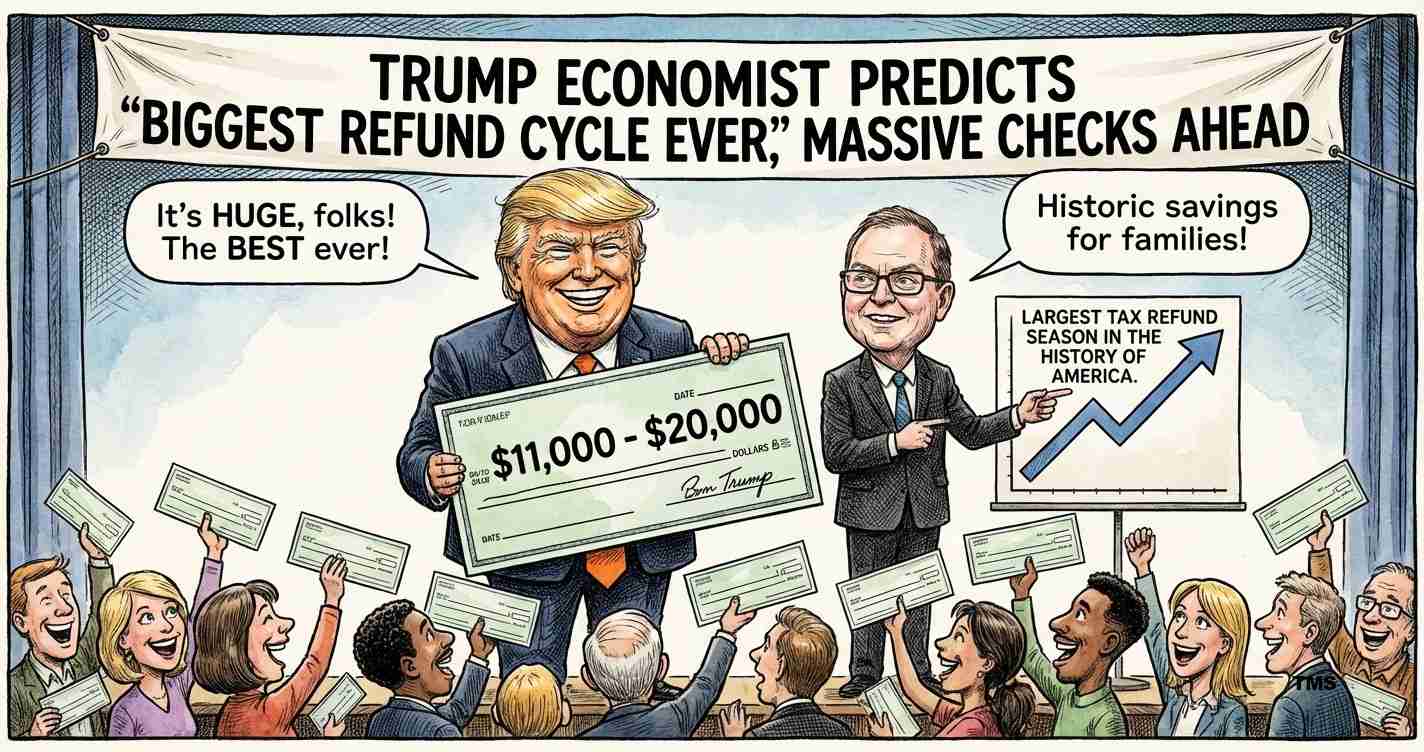
Trump economist predicts “biggest refund cycle ever”; White House says Massive 2026 Tax Refunds ahead after One Big Beautiful Bill Act
Kevin Hassett and White House officials predict unusually large tax refunds in spring 2026 after passage of the One Big Beautiful Bill Act, while independent analysts offer more modest $1,000–$2,000 household estimates and public skepticism persists.
Key takeaways
- Hassett and the president: Kevin Hassett and President Trump say the One Big Beautiful Bill Act will trigger unusually large refunds in spring 2026 — report via Fox Business.
- More modest official analyses: The White House and outside analysts cite narrower figures — Karoline Leavitt (~$1,000), Piper Sandler (~$91B refunds + $30B reduced withholding), and Treasury Secretary Scott Bessent ($1,000–$2,000 per household) — per CPA Practice Advisor.
- Policy drivers: Higher standard deductions, an expanded Child Tax Credit, exemptions on tips/overtime, and a raised SALT cap are cited as the main drivers — see summaries from TurboTax and the IRS.
What officials are saying
Kevin Hassett, former National Economic Council director and Fed chair contender, told reporters the OBBBA’s tax changes will create “massive refund checks” next spring, calling it the “biggest refund cycle ever in the history of America.” He emphasized the law’s mid-summer passage left many filers’ forms unchanged for much of 2025. Source: Fox Business.
“This will be the biggest refund cycle ever in the history of America,” — Kevin Hassett (reported)
President Trump presented a wide range of potential household savings — saying families could see between $11,000 and $20,000 annually from the new rules — a headline number notably larger than other estimates. Source: Fox Business.
White House spokespeople offered narrower projections: Press Secretary Karoline Leavitt suggested roughly an extra $1,000 in refunds for many Americans; Piper Sandler estimated about $91 billion in added refunds plus roughly $30 billion from reduced withholding; Treasury Secretary Scott Bessent put typical household gains at about $1,000–$2,000. Source: CPA Practice Advisor.
How the One Big Beautiful Bill Act would raise refunds
Analysts point to several policy changes in the OBBBA that could boost refunds for 2025 returns filed in spring 2026. Key provisions include:
- Standard deduction increases: The law raised 2025 filing-level standard deductions to about $31,500 for married filing jointly, $15,750 for singles, and $24,150 for heads of household (with inflation adjustments), lowering taxable income for many filers. Source: TurboTax.
- Child Tax Credit expansion: The act expands the Child Tax Credit, directly reducing tax bills for families with children; exact household impacts vary across statements. Sources: CPA Practice Advisor and TurboTax.
- Exemptions for tips, overtime and select wages: Targeted exemptions reduce taxable income for many service and blue-collar workers, increasing take-home pay and potentially refunds. Source: CPA Practice Advisor.
- SALT cap increase: The cap for state and local tax deductions rises to $40,000 for 2026–2029, helping taxpayers in high-tax states more than those in states without income tax. Source: TurboTax.
Timing and mechanics: why refunds may spike in 2026
A central explanation officials give is simple timing. Because the OBBBA passed in mid‑summer 2025, many taxpayers and payroll systems used withholding tables and forms earlier in 2025 that did not reflect the new provisions. That mismatch can produce retroactive adjustments or larger refunds when people file 2025 returns in spring 2026. Officials argue these delayed adjustments could create a one‑time surge in refunds for 2026 filings. Source: Fox Business.
Pushback and public skepticism
Public polling shows widespread concern about personal finances: a Fox News Poll found 44% of respondents say they are falling behind and 74% view the economy as “not so good” or “bad.” Hassett disputed that view by citing wage growth and low core inflation: he pointed to about 3.7% nominal wage growth and 1.6% core inflation, implying roughly 2–2.5% real wage gains for many workers and noting blue-collar workers saw roughly $2,000 more in real terms after inflation. Source: Fox Business.
Independent analysts show a wider range of plausible outcomes than the most optimistic White House headlines. While the administration emphasizes possibly very large one‑time effects, outside projections and Treasury statements typically point to more modest typical household gains in the $1,000–$2,000 range. Source: CPA Practice Advisor.
Evidence and limits
The administration’s optimism rests on concrete statutory changes, but actual refund sizes will depend on:
- How quickly and fully employers update withholding.
- Taxpayers’ filing choices and the mix of income types in households.
- IRS processing and the handling of mid‑year or retroactive changes.
Analysts caution that one‑time timing effects can inflate 2026 refunds without representing permanent, year‑over‑year increases of the very large amounts some officials cited. Sources: TurboTax and CPA Practice Advisor.
Implications for Las Vegas, Nevada
Economic impact
Las Vegas’ economy is concentrated in hospitality, tourism and service work. Many local employees rely on tips and overtime: OBBBA exemptions for those wage components could reduce taxable income or alter withholding, producing noticeable short‑term gains when refunds arrive in spring 2026. The Child Tax Credit expansion could also ease household budgets for families with children in the region. Sources: CPA Practice Advisor and TurboTax.
However, because Nevada has no state income tax, the raised SALT cap will not directly benefit most Nevada taxpayers — SALT increases primarily help residents of high‑tax states. Source: TurboTax.
Political consequences
Nevada is a swing state. If sizable refunds materialize for Las Vegas households in 2026, that outcome could influence local views of the Trump administration’s economic policies. If promised relief is not widely felt, public skepticism and economic pain could deepen — a dynamic reflected in recent polling (44% falling behind). Source: Fox Business.
Social effects
Many Las Vegas households live paycheck to paycheck. Even a one‑time boost of $1,000–$2,000 could help cover rent, utilities, car repairs, or school costs. The Child Tax Credit expansion could reduce child poverty and financial stress. But if the administration’s larger $11,000–$20,000 claims are overstated for most households, unmet expectations could fuel frustration. Sources: CPA Practice Advisor and Fox Business.
Cultural relevance
Las Vegas’ youthful, service‑oriented workforce makes changes to tips and take‑home pay especially salient locally. Community organizations and nonprofits should prepare for uneven benefits across households and the specific timing of potential refunds.
Practical applications for residents
- Check withholding early in 2026: Discuss adjustments with payroll or tax preparers to understand how OBBBA changes affect individual refunds. Source: Fox Business.
- Confirm Child Tax Credit eligibility: Families should verify eligibility and prepare any required paperwork to claim expanded credits. Sources: CPA Practice Advisor and TurboTax.
- Tip and overtime earners: Review pay statements and consult payroll departments about how tips/overtime are reported after the law change. Source: CPA Practice Advisor.



