More Americans Falling Behind on Car Payments as Auto Loan Delinquencies Hit 5.1% in 2025
New data shows U.S. auto loan delinquencies climbed to 5.1% in Q1 2025, as rising interest rates, inflation and resumed federal student loan payments push many Americans—especially younger and subprime borrowers—into car payment arrears again.
Key takeaways
- 5.1% of Americans with auto loans were delinquent on at least one account in Q1 2025 (LendingTree).
- Gen Z and millennials show the highest delinquency rates: Gen Z 7.5%, millennials 6.9% (LendingTree).
- Southern states lead delinquencies — Mississippi topped the list at 9.8% (LendingTree).
- The resumption of federal student loan payments is a major driver pushing borrowers into car payment arrears (Morningstar/MarketWatch).
Rising delinquencies: the numbers and where they stand
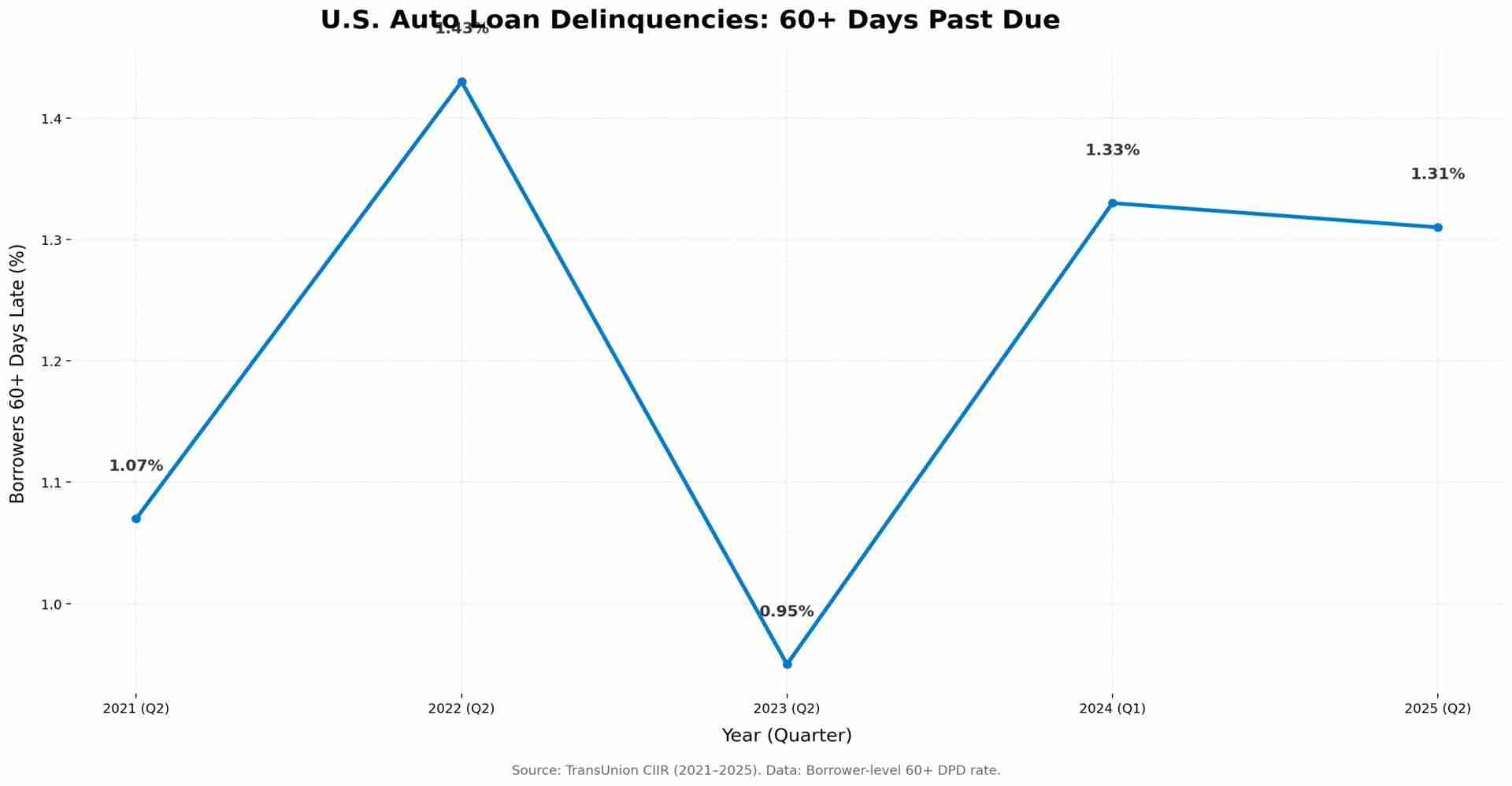
Auto loan delinquencies have climbed markedly in 2025 after a period of unusually low late payments during the pandemic. LendingTree’s quarterly analysis found that 5.1% of Americans with auto loans were delinquent on at least one account in Q1 2025 — including 2.0% who were 30 days late, 0.9% who were 60 days late, and 0.9% who were 90–120 days overdue (LendingTree).
State-level results show wide variation: Mississippi had the worst rate at 9.8%, followed by Louisiana (8.4%) and Georgia (7.8%). By contrast, Alaska, Utah, Washington and New Hampshire reported the lowest delinquencies at about 3.2% (LendingTree). Overall, 22 states were above 5% while 28 were below that mark (LendingTree).
Who is most affected
Younger borrowers stand out. Gen Z carries the highest delinquency rate at 7.5%, followed by millennials at 6.9%. By comparison, baby boomers are far less likely to miss payments, at about 1.9% delinquent (LendingTree).
Subprime borrowers (credit scores below 620) are especially vulnerable. Experts say missed student loan payments are lowering credit scores, moving more people into the subprime category and increasing the chance they’ll fall behind on car loans (Morningstar/MarketWatch).
Why delinquencies are rising now
Economists point to several converging forces in 2025:
- Student loan repayment resumed for millions earlier this year; borrowers who bought cars during the payment pause now face two monthly bills, increasing arrears risk (Morningstar/MarketWatch).
- High interest rates and persistent inflation have raised borrowing and living costs, squeezing household budgets (LendingTree).
- Larger balances and longer terms after the pandemic mean higher monthly payments; when budgets tighten, missed payments rise (LendingTree).
Changing payment priorities
Historically, borrowers often prioritized car payments over unsecured debts like credit cards. That pattern is shifting: seriously delinquent student-loan borrowers are now more likely to fall behind on both auto loans and credit cards as they try to catch up on student debt (Morningstar/MarketWatch).
Between December 2024 and June 2025, auto loan delinquencies among this group rose from 3.8% to 6.3% — a 67% increase (Morningstar/MarketWatch).
Industry impact and the risk of escalation
So far, increases in late payments have not produced a sharp rise in outright defaults. Defaults were only slightly up in recent months and remained down year over year by some measures, but analysts warn a sustained delinquency rise could ripple into the broader economy (Morningstar/MarketWatch).
Lenders are responding by restructuring payments, offering temporary relief, or refinancing loans to avoid repossessions. However, rising delinquencies may curtail lending or push borrowers into higher-cost subprime loans, worsening future payment problems (Morningstar/MarketWatch).
Auto loan balances and longer trends
Total outstanding auto loan balances fell slightly to $1.642 trillion in Q1 2025, a rare quarterly decline (down 0.8%), which may indicate fewer loans or smaller loan sizes (LendingTree).
Over the past 15 years, auto loan delinquencies are up more than 50% compared with earlier levels, ending a long stretch of relatively low late payments that followed the pandemic (see reporting from AOL and the New York Fed).
Gen Z auto debt and the long tail of student loans
Young borrowers face two mounting problems: rising Gen Z auto debt (higher monthly payments and longer loan terms) and the restart of student loan repayments. The result: more young people slipping into car payment arrears, with potential long-term damage to credit histories and economic mobility (LendingTree; Morningstar/MarketWatch).
Implications for Las Vegas, Nevada
Economic impact: Las Vegas is car-dependent for many residents. Rising auto loan delinquencies could squeeze household budgets in Clark County, where hourly wages in tourism, hospitality and service jobs predominate. If car payments rise or repossessions increase, local spending could slow and affect small businesses.
Transportation and daily life: Losing a car can mean losing a job in Las Vegas — public transit does not reach all neighborhoods or shifts. Higher delinquency among younger workers could make commuting and job retention harder.
Housing and affordability: Larger car payments reduce what households can afford for rent or mortgages. In a market with tight housing costs, higher auto debt may increase demand for more affordable or shared housing.
Local lenders and dealers: Dealers and lenders may tighten credit or offer longer terms locally — lowering monthly payments short-term but increasing long-term interest and delinquency risk. Credit unions and community groups could help with refinancing or counseling.
Policy and services: Local officials may face pressure to expand financial counseling, job training and transit options. The link between student loan repayments and auto delinquencies could prompt calls for consumer protections or expanded support.
Practical steps for Las Vegas residents
- Contact your lender early to discuss hardship programs or temporary relief.
- Check credit union refinancing options that may lower your rate or monthly payment.
- Seek free or low-cost credit counseling from local nonprofits before delinquency escalates.
- Explore transit or carpool options to reduce transportation costs while stabilizing finances.
- Track your budget, prioritize secured payments and seek guidance to avoid long-term credit damage.
“Rising delinquencies are an early warning — lenders and policymakers should act to prevent a broader credit and economic shock.”
Sources and further reading
- LendingTree, auto loan delinquency study
- Morningstar / MarketWatch analysis on student loan repayments and auto delinquencies
- AOL report on rising auto loan delinquencies
- New York Fed, studies on consumer credit
Reporting by Times Media Service