After 177 years, Schlitz beer ends production — ceremonial final batch brewed May 23 as nostalgia and criticism surface
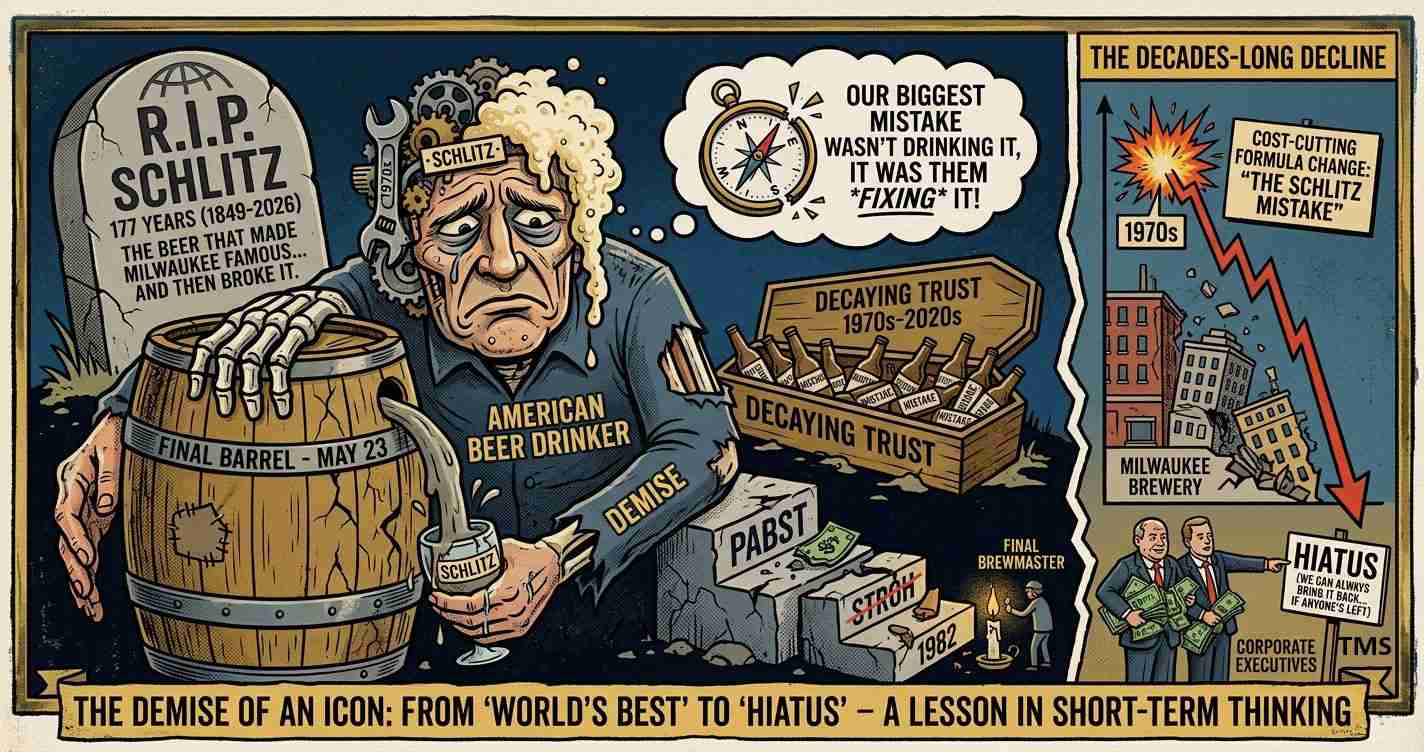
On May 23 in Verona, Wisconsin, veteran brewmaster Kirby Nelson brewed a ceremonial final batch of Schlitz beer as Pabst Brewing Company retires the 177‑year‑old brand, citing rising costs and low sales and ending an iconic era.
- Pabst is retiring the Schlitz brand and brewed a final ceremonial run on May 23 at Wisconsin Brewing Co.
- Company cites rising storage, shipping and supply‑chain costs that make low‑volume legacy brands uneconomical
- Schlitz rose from an 1849 Milwaukee brewery to a national leader, but mid‑century recipe changes and competition eroded trust
- Local cultural memory (e.g., Encyclopedia of Milwaukee) and collectors will preserve the brand’s legacy
Schlitz’s rise: from local brewery to national name
The Joseph Schlitz Brewing Company began in Milwaukee in 1849 when Joseph Schlitz took over a small brewery previously owned by August Krug. Over decades the company expanded through heavy advertising and distribution, tying Milwaukee’s identity to beer-making and earning the slogan “the beer that made Milwaukee famous.” Historical context and details are cataloged by the Encyclopedia of Milwaukee.
A major turning point was the Great Chicago Fire of 1871: Schlitz moved quickly to fill demand in Chicago, expanding market share and converting from a regional brewer into a national force. By the post‑World War II era, Schlitz ranked among America’s best‑selling beers.
The “Schlitz mistake”: how a recipe change cost brand trust
Industry historians point to cost‑cutting moves in the 1960s and 1970s — shorter fermentation times, ingredient adjustments and processing shortcuts — now often called the “Schlitz mistake.” Those changes altered flavor and, many longtime drinkers say, destroyed trust.
“Real Schlitz definitely had its own taste. Original formula was decent. Then it became swill,” wrote one user on X, capturing a common blend of nostalgia and scorn online.
Beer writers and histories (see AmericanCraftBeer.com) use the episode as a cautionary tale: quality erosion can permanently damage a brand even if the product remains on shelves.
Competition and ownership changes
National competitors such as Anheuser‑Busch and Miller prioritized consistent quality, logistics and marketing, eroding Schlitz’s market share. The brand changed hands multiple times; in 1999 Pabst Brewing Company acquired Schlitz and maintained it as a low‑volume heritage label. Occasional reissues of earlier formulas targeted nostalgic drinkers but did not restore major‑market status.
Why the final batch now
Pabst’s head of brand strategy, Zac Nadile, told Milwaukee Magazine that retirement was driven by cost and complexity: “keeping small, low‑velocity SKUs requires separate storage, labeling and shipping logistics that are expensive relative to the sales they generate.”
The May 23 brew at Wisconsin Brewing Co. in Verona served as both a practical final run and a ceremonial send‑off to a once‑ubiquitous brand.
Schlitz’s physical and cultural footprint
The original Joseph Schlitz brewery complex in Milwaukee has been redeveloped into Schlitz Park, a mixed‑use campus that preserves historic architecture and the Schlitz name. Schlitz advertising remains part of marketing case studies and memorabilia collections across the country.
Public reaction: memory, mockery and market reality
Online responses ranged from wistful reminiscence to biting criticism: older users and collectors shared family stories and fraternity nights, while others recalled the taste shift and mocked the product’s later reputation. The mix of sentiment and ridicule highlights how a brand can occupy complex cultural space as both beloved artifact and cautionary example.
What ends and what remains
With the ceremonial final batch and depleted inventory, Schlitz will cease as a regular market product. The name will continue locally (in Schlitz Park), among collectors and in historical accounts. Pabst Brewing Company will focus on other legacy labels where production and supply‑chain efficiencies make commercial sense.
Implications for Las Vegas, Nevada
Economic impact
Direct economic effects in Las Vegas are expected to be minimal: Schlitz was no longer a high‑volume seller. However, the retirement reflects an industry trend toward a narrower set of high‑volume brands and local craft producers. Bars and distributors that feature nostalgic or heritage beers may need to adjust sourcing or price collectible bottles higher.
Political consequences
There are no immediate local political consequences for Las Vegas, but the decision underscores how corporate supply‑chain choices affect distribution and warehousing jobs nationwide. Nevada lawmakers and regulators concerned with food‑and‑beverage resiliency may cite such retirements in broader policy discussions.
Social effects
Schlitz’s end will resonate among older residents and visitors who tie the brand to family traditions and past social life. For Las Vegas’s tourism and convention economy, the loss of heritage brands can slightly alter the mix of nostalgia‑based offerings at themed bars and collector events.
Cultural relevance
Las Vegas, which trades in nostalgia and themed experiences, may see local events, tastings or memorabilia markets highlighting Schlitz artifacts. Breweries and beer museums could use the moment to discuss brand stewardship and product consistency to avoid repeating the “Schlitz mistake.”
Practical applications for businesses and residents
- Bars and retailers: Audit remaining Schlitz inventory, communicate availability to customers, and consider themed nights that blend nostalgia with historical context.
- Collectors and sellers: Expect heightened interest in Schlitz cans, signs and paraphernalia; document provenance and price accordingly.
- Local breweries: Use the story as a marketing touchpoint to emphasize quality and consistency compared with mid‑century mass‑production shortcuts.
Sources
- Encyclopedia of Milwaukee — Joseph Schlitz Brewing Company
- Milwaukee Magazine — reporting on Pabst’s decision and quotes from Zac Nadile
- AmericanCraftBeer.com — historical account of Schlitz recipe changes
- Pabst Brewing Company — official site
- Wisconsin Brewing Company
- Schlitz Park
- Wikipedia — Joseph Schlitz Brewing Company
- X (formerly Twitter) — public reactions