Protester Scales Iranian Embassy in London, Tears Down Regime Flag and Hoists Lion and Sun Banner Amid Europe‑wide Rallies
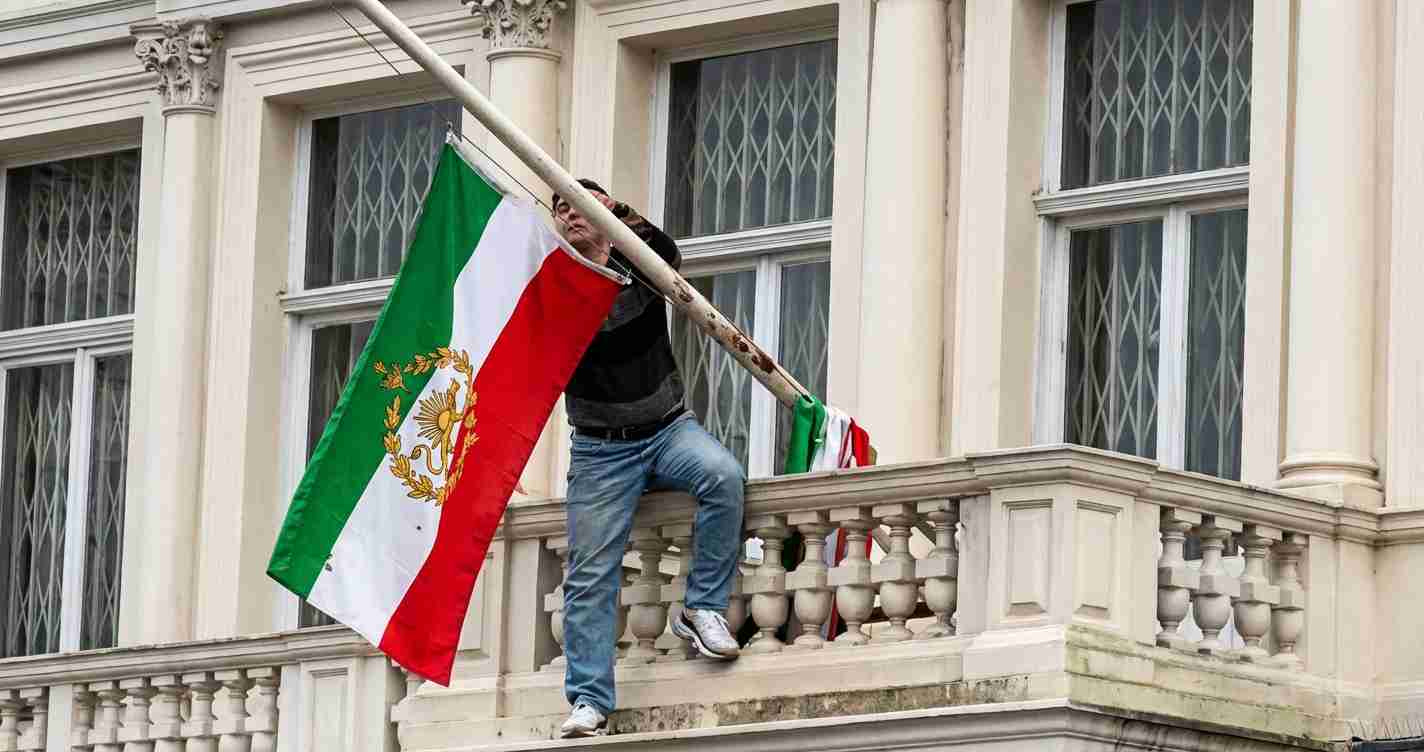
A protester climbed the Iranian Embassy in Kensington, London, on Saturday, January 10, 2026, removed the Islamic Republic flag and briefly hoisted the pre‑1979 Lion and Sun banner amid large solidarity rallies across Europe and beyond.
- High‑profile symbolic act: A man scaled the embassy façade and replaced the Islamic Republic flag with the Lion and Sun banner used before 1979.
- Crowd response and policing: Hundreds cheered and chanted while the Metropolitan Police arrested two people and sought a third; patrols were increased to protect the mission.
- Part of wider movement: The incident occurred during Europe‑wide solidarity protests amid weeks of unrest and a reported violent crackdown inside Iran.
The London flag incident: what happened
Video and eyewitness accounts show a man climbing the embassy’s front balcony, removing the Islamic Republic flag and raising the Lion and Sun flag flown under the Pahlavi monarchy before the 1979 revolution. The replacement flag reportedly remained for several minutes before it was taken down again. The episode was widely shared on social media and captured on short video clips, including a brief clip archived as Video of the London incident (short).
Key published coverage described the moment and the scene outside the embassy; see reporting by Times of Israel: Protester replaces Islamic Republic flag with Shah‑era banner at Iran’s London embassy and a summary at EADaily.
Crowd response and police action
Hundreds gathered and cheered, with demonstrators chanting “Democracy for Iran,” “Shah Reza Pahlavi,” and “Justice for Iran.” Many held “Free Iran” placards. The Metropolitan Police said two people were arrested — one on suspicion of aggravated trespass and assault on an emergency worker, another for aggravated trespass — and officers were seeking a third person linked to the flag incident. Authorities increased patrols to protect embassy staff and property; details reported by Times of Israel.
Why the Lion and Sun flag matters
The Lion and Sun motif has appeared on Iranian banners for centuries and became central under the Pahlavi monarchy. Today the green‑white‑red tricolor bearing the Lion and Sun is widely used by opposition groups and diaspora communities as a symbol of resistance to the Islamic Republic. Its display at protests signals both a rejection of the current system and an appeal to an alternative national narrative; analysts and participants highlighted this symbolism in the days after the incident.
Opposition leaders and dynamics
Exiled crown prince Reza Pahlavi has been a prominent voice urging stepped‑up pressure on the regime. He has publicly called on demonstrators to seize and hold city centers and said he is preparing to return when conditions allow. Media noted a video he posted on platform X urging forceful action to topple the current government; those calls have been polarizing even among opponents of the regime. (See coverage summarized in Times of Israel and EADaily).
Solidarity rallies across Europe and beyond
The embassy incident was part of a wider wave of demonstrations by Iranians living abroad. Demonstrations were reported in Berlin and Cologne in Germany, Stockholm in Sweden, and earlier in Paris, Brussels and Washington, D.C., with many gatherings held outside Iranian embassies or major government buildings. Coverage of the broader European rallies is available at Iran International: London, Berlin, Stockholm join solidarity rallies with Iran protesters.
Situation inside Iran: casualties, repression and information blackout
Rights monitors and diaspora groups report a deadly crackdown. The U.S.‑based Human Rights Activists News Agency (HRANA) has been cited as reporting at least 72 people killed and more than 2,300 detained during the current protests; those figures are circulated by outlets including Iran International and Times of Israel. Independent verification is limited by periodic internet shutdowns and restrictions on information flow.
State media and senior leaders in Tehran have characterized protesters as agents of foreign enemies, with officials promising to confront what they describe as “sabotage.” By contrast, independent human‑rights reporting documents security forces using tear gas and live ammunition and stresses demonstrators’ calls for broader civil and political rights.
International reaction and political signaling
Western governments have condemned killings and mass arrests and urged Tehran to respect peaceful protest rights. In Britain, Foreign Secretary Yvette Cooper said the UK and partners denounced the use of lethal force and urged protection of fundamental rights. Most Western responses have avoided endorsing specific opposition factions.
The London episode circulated widely online and was picked up by commentators and politicians internationally; it was also shared by former U.S. President Donald Trump, illustrating how the incident resonated beyond diasporic communities and campaign rallies (Iran International coverage).
Security and diplomatic implications
Attacks on or removals of national flags raise security and diplomatic concerns for host countries and missions. The London authorities moved quickly to protect the embassy after the incident and emphasized balancing the right to protest with obligations to protect diplomatic premises. Arrests indicate a policing response intended both to deter disorder and to uphold diplomatic safeguards.
Implications for Las Vegas, Nevada
Las Vegas hosts a diverse Iranian and Middle Eastern diaspora that closely watches developments in Iran. Potential local impacts include:
- Economic and community ties: Local Persian‑language businesses, cultural centers and restaurants may become hubs for organizing, fundraising and information sharing, affecting foot traffic and commerce in neighborhoods where Iranian Americans gather.
- Political consequences: City and county leaders in Las Vegas could face constituent pressure to issue statements, hold vigils, or pass symbolic resolutions; federal representatives from Nevada may see constituent engagement on related policy issues.
- Social and cultural effects: Families with ties to Iran may seek forums, counseling or community spaces; debates over pre‑1979 symbols such as the Lion and Sun can influence local cultural events and political organizing.
- Practical considerations: Local demonstrations could affect traffic near civic spaces; officials and media should prepare verified bilingual information and coordinate with community leaders to ensure peaceful assembly and public safety.
Sources and further reading
- Times of Israel: Protester replaces Islamic Republic flag with Shah‑era banner at Iran’s London embassy
- EADaily summary: The flag was dropped from the facade of the Iranian embassy in London; replaced with a pre‑revolutionary one
- Iran International: London, Berlin, Stockholm join solidarity rallies with Iran protesters
- Video of the London incident (short)
[Reporting by Times Media Service; sources as cited above]