
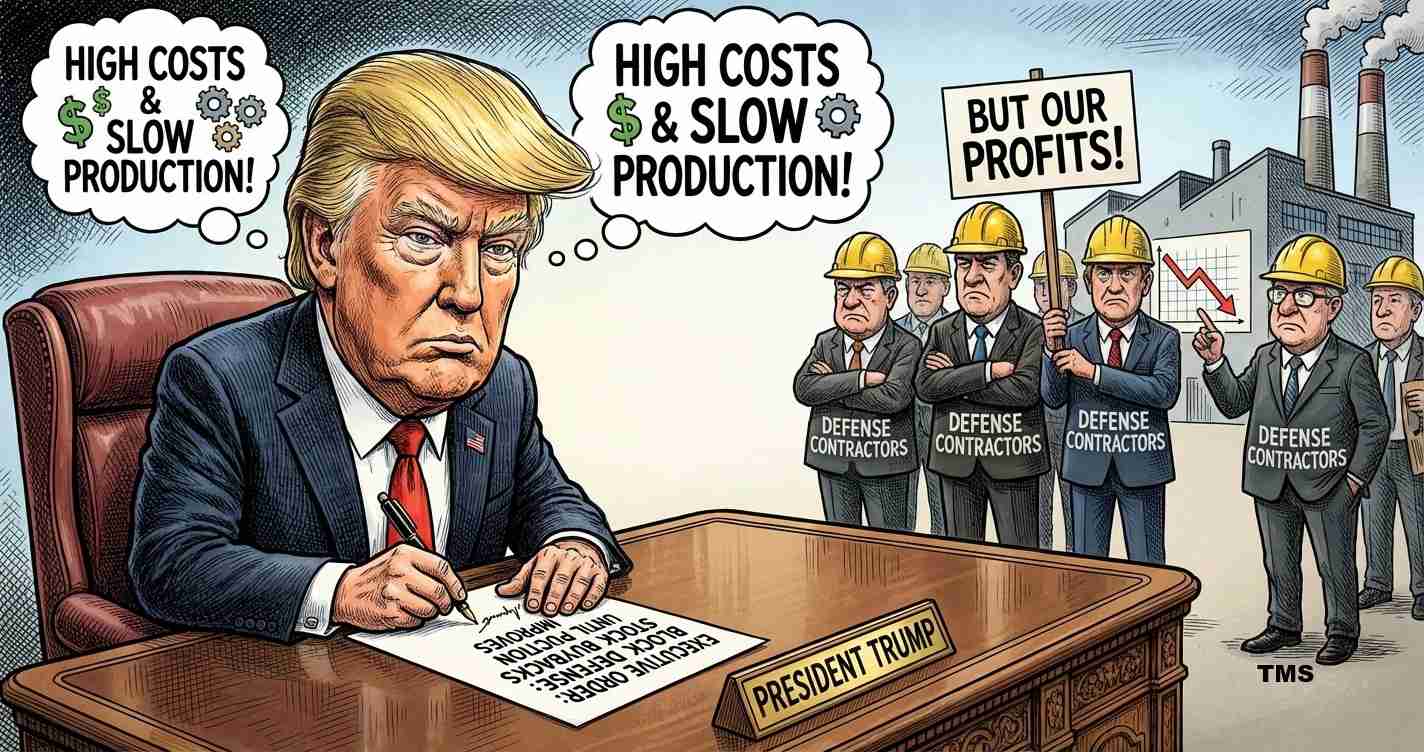
Trump Signs Order Blocking Underperforming Defense Firms From Dividends, Buybacks; Caps Pay Tied to Production
President Donald Trump signed an executive order immediately blocking underperforming U.S. defense contractors from paying dividends or buying back stock and directing pay limits and incentive changes until weapons production and delivery improve.
Key takeaways
- Bars defense contractors from dividends and buybacks until they demonstrate improved delivery, quality and on‑budget performance.
- Limits on executive pay and incentive plans tie rewards to production and delivery rather than short‑term financial measures; base pay could be capped.
- Framing: “prioritizing the warfighter” — the White House says industry priorities shifted toward shareholder returns at the expense of production capacity.
What the executive order does
The order targets U.S. companies that hold government defense contracts and are judged to be underperforming on cost, schedule or production speed. It states such firms “are not permitted in any way, shape, or form to pay dividends or buy back stock” until they can show they produce superior products on time and on budget. The initial reporting is summarized by Breaking Defense.
Pay and incentive changes
The order requires that executive incentive pay be tied to performance metrics such as on‑time delivery and program success, rather than metrics that can be boosted by buybacks or short‑term financial engineering. The White House fact sheet explains that base pay could be capped at current levels (with only inflation adjustments allowed) while incentive plans must reward production and delivery improvements. See additional reporting at Fox Business.
Why the White House says it acted
Administration officials argue that large defense firms prioritized shareholder returns and high executive pay over investing in plants, tooling and production capacity. They point to years of dividends and buybacks that, they say, left firms underprepared to deliver equipment quickly. Politico reported that the largest primes spent roughly $89 billion on buybacks and dividends from 2021–2024 (Politico).
Public comments and administration tone
President Trump used forceful language in public remarks. He said:
“MILITARY EQUIPMENT IS NOT BEING MADE FAST ENOUGH!”
He also singled out RTX (Raytheon) by name as a firm under scrutiny; reporting on his remarks and tone appears in Defense One and Breaking Defense.
Who is covered and how the policy will work
The order directs the Secretary of Defense (referred to in White House materials as the Secretary of War) to identify underperforming contractors within 30 days. Those firms must be notified and asked to submit remediation plans within about 15 days describing how they will speed production, fix delays and increase investment in plants and equipment (Fox Business; White House fact sheet).
Within roughly 60 days, the Pentagon must add contract language to future awards that can bar buybacks and dividends during periods of underperformance and allow the government to scrutinize or cap executive base pay for contractors that do not meet standards. The order also permits pausing advocacy for certain contractors in foreign military sales until problems are fixed (Breaking Defense; White House fact sheet).
Mentioned companies and the White House focus
The White House and reporting note major primes such as Lockheed Martin, RTX (Raytheon Technologies), General Dynamics, and Northrop Grumman as companies that used large amounts of cash for buybacks and dividends. The administration specifically named RTX in public comments as a company that must stop buybacks to remain eligible for work (Breaking Defense; Politico).
Market reaction and industry response
Stocks fell after the announcement, with broad declines across the defense sector. Early reports showed afternoon New York trading moves roughly: Lockheed Martin down ~4.8%, Northrop Grumman down ~5.5%, General Dynamics down ~3.6% (initial media accounts vary; see Politico, Breaking Defense, Defense One).
Several big contractors declined comment or had not responded; analysts raised questions about the order’s legal reach and practical effect. Experts note the president’s direct authority over private corporate pay is limited, and that procurement rules may be the primary enforcement tool (Politico).
Legal and policy questions
Legal scholars and industry lawyers told reporters the order will likely be enforced mainly through procurement conditions — making companies ineligible for certain contracts unless they meet benchmarks — rather than by directly policing boardroom decisions. Critics argue boards and shareholders decide buybacks and dividends, and firms may resist costly plant investments without long-term contracting certainty. The administration counters it plans to offer larger, longer-term contracts and incentives to expand capacity (Politico; Defense One).
Policy context
The action accompanies the administration’s push for significantly higher Pentagon spending — President Trump has advocated roughly a 50% increase to reach about $1.5 trillion in annual defense spending — arguing that more funding plus tougher rules will expand capacity and discipline the industry. The White House frames the step as part of a larger effort to “prioritize the warfighter” (Defense One; White House fact sheet).
Where the public record is thin
Officials outlined broad timelines but left open questions about the Pentagon’s scoring systems to designate firms “underperforming,” the exact size of any pay caps, and the long-term investment impact. Analysts say more detail is needed to judge how much capital will be redirected to factories and how quickly production will accelerate (Politico; Breaking Defense).
Implications for Las Vegas, Nevada
Economic impact
Nevada hosts suppliers and a growing aerospace and defense workforce tied to national programs. If primes are pushed to invest in plants and tooling, local subcontractors near Las Vegas could see new orders for parts and services, potentially boosting manufacturing, maintenance and logistics jobs. Conversely, if contractors slow hiring while reworking contracts or pursuing legal challenges, local businesses that serve defense workers could face a short-term dip.
Political consequences
Nevada officials across parties will monitor criteria and timelines closely. Lawmakers who support defense jobs may press the Pentagon for clear, fast scoring so local companies can fairly compete for new production work. Urban moderate voters in Las Vegas may favor stronger oversight tied to local jobs and better taxpayer value.
Social and cultural effects
Faster deliveries and stronger maintenance could benefit service members and veterans in Nevada who rely on base operations and readiness. Framing the policy as “prioritizing the warfighter” may resonate in Las Vegas among residents who want well‑equipped U.S. forces without seeing public funds flow mainly to shareholder payouts.
Practical applications for residents
Local suppliers of parts, maintenance or tech services should monitor Pentagon solicitations over the next 60 days and be ready to demonstrate scaling and on‑time delivery plans. Job seekers in manufacturing and logistics should watch for announcements from primes about new investment or remediation plans that could lead to hiring.



